All comparisons
Synthflow Alternatives

Best Synthflow Alternatives in 2026

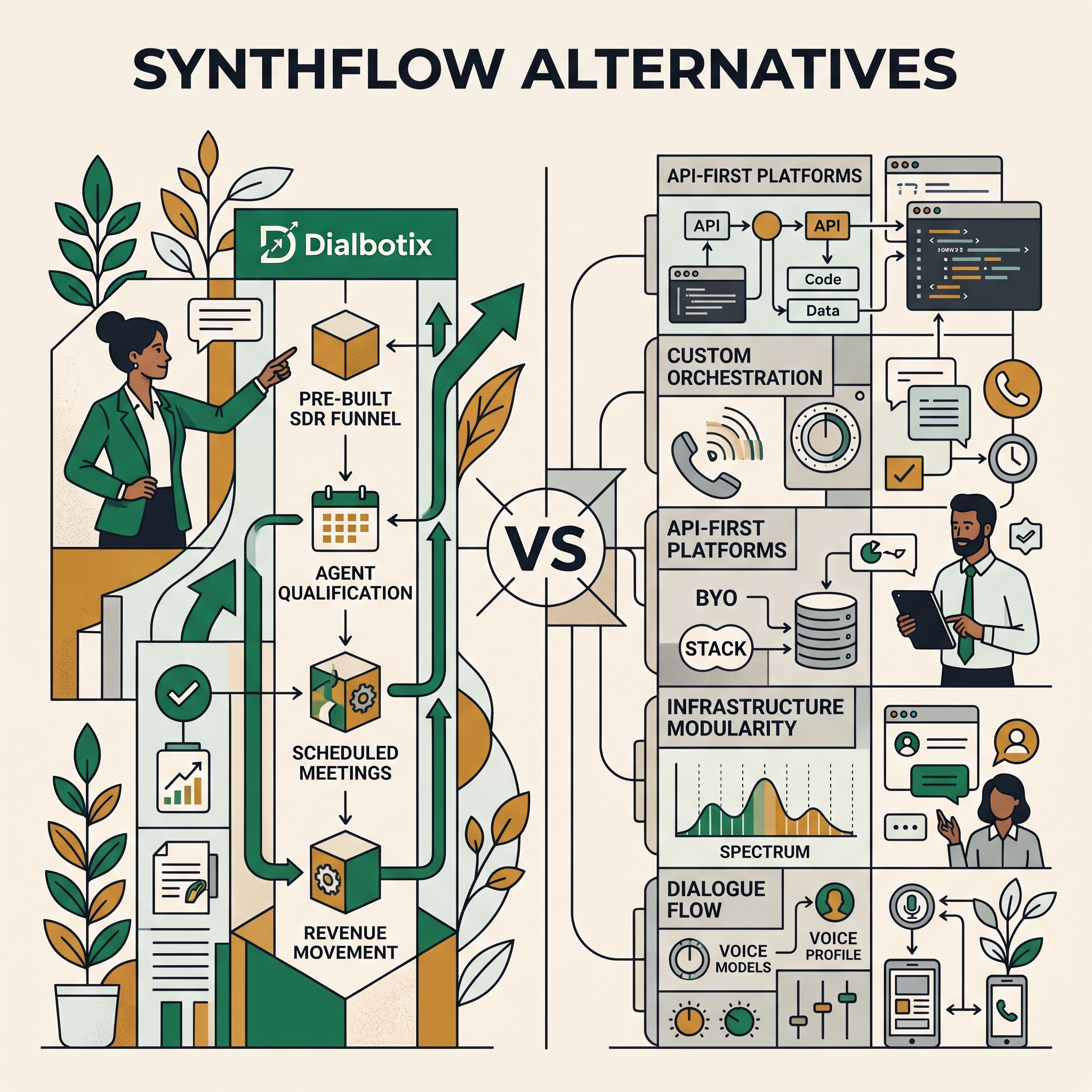
Synthflow is a powerful no-code voice AI platform, but it is not the ideal fit for every business. We compared the strongest Synthflow alternatives across outbound calling, lead qualification, appointment booking, CRM connectivity, deployment speed, sales workflows, developer flexibility, and pricing.

Overview
Why look for a Synthflow alternative?

Why look for a Synthflow alternative?

Synthflow is built for businesses that want to create AI-powered phone workflows without traditional software development. It supports inbound and outbound voice agents, CRM integrations, scheduling, automation, telephony, and workflow logic.

The important question is not whether Synthflow can perform a particular task. It can support a broad range of phone workflows, including outbound calling, CRM synchronization, scheduling, and automated actions. The more useful question is whether its broad workflow model matches the specific problem you are trying to solve.

For a business that needs general-purpose voice automation across multiple departments, Synthflow can be a strong choice and there's little reason to look elsewhere. But if the primary objective is outbound sales, lead qualification, and appointment booking, a more specialized product can reduce the amount of workflow construction required before your first campaign is live.

Dialbotix is positioned specifically around that sales workflow. It is a no-code AI voice agent platform where teams can set up an AI voice agent in about two minutes without writing a single line of code, then use it to call leads, qualify prospects, book meetings, and update sales systems.

This comparison therefore separates general voice automation platforms from purpose-built sales systems instead of treating every AI voice product as interchangeable — and calls out where sticking with Synthflow makes more sense than switching.

Who it's for

Who should consider a Synthflow alternative?

Synthflow is broad by design. An alternative becomes more attractive when your requirements are narrower, more technical, more sales-specific, or more focused on a different deployment model.

Outbound sales teams

Teams that want an AI voice agent dedicated to calling lead lists, qualifying prospects, following up, and booking sales meetings.

Teams that want faster setup

Businesses that prefer a focused sales workflow instead of designing a broader voice automation system before launching their first campaign.

Developer teams

Engineering teams that want direct control over the voice stack, models, APIs, telephony, and custom application logic.

Appointment-setting agencies

Agencies that need a repeatable way to deploy outbound AI voice agents across clients and campaigns.

Teams with dormant leads

Businesses with old CRM leads that need automated reactivation, qualification, and follow-up instead of manual calling.

High-volume calling teams

Organizations that need to compare platforms specifically around calling volume, concurrency, telephony, and per-call economics.

Methodology

How we evaluated Synthflow alternatives

We evaluated alternatives based on the actual workflow businesses need to operate, not simply on how many voice features a platform lists.

  1. 01

    Voice AI

    Can the platform conduct real-time phone conversations with natural conversational behavior?

  2. 02

    Outbound calling

    Can it automatically work through lead lists and initiate outbound conversations at meaningful volume?

  3. 03

    Lead qualification

    Can the agent ask questions, understand answers, and determine whether a prospect meets the qualification criteria?

  4. 04

    Appointment booking

    Can the platform turn buying intent into an actual calendar booking during or immediately after the conversation?

  5. 05

    CRM connectivity

    Can call outcomes and prospect information be synchronized with the CRM or other business systems?

  6. 06

    No-code deployment

    Can non-technical users configure and operate the agent without writing application code?

  7. 07

    Sales specialization

    Does the platform already model sales concepts such as leads, campaigns, qualification, follow-up, and meeting outcomes?

  8. 08

    Developer flexibility

    How much control does the platform provide for teams building custom voice applications?

  9. 09

    Pricing

    Is the pricing transparent and appropriate for the expected volume and workflow?

At a glance

Quick comparison of Synthflow alternatives

The platforms below overlap in voice AI but are positioned differently. Some focus on general voice automation, some on voice infrastructure, and others on sales-specific workflows.

DialbotixThis one

From $79/mo

Voice AI
Lead Qualification
Built in
Booking
Built in
CRM
HubSpot, Salesforce, webhooks, API
Outbound
Purpose-built
Synthflow

Sales-led

Voice AI
Lead Qualification
Booking
CRM
HubSpot, Salesforce, integrations
Outbound
Retell AI

$0.07–$0.31/min

Voice AI
Lead Qualification
Booking
CRM
Integrations + API
Outbound
Bland AI

Usage-based

Voice AI
Lead Qualification
Booking
CRM
API / integrations
Outbound
Strong
Vapi

Usage-based

Voice AI
Lead Qualification
Build it
Booking
Build it
CRM
API / integrations
Outbound
ElevenLabs

Usage-based

Voice AI
Lead Qualification
Build workflow
Booking
Build workflow
CRM
API / integrations
Outbound
Possible
PolyAI

Custom

Voice AI
Lead Qualification
Booking
CRM
Enterprise integrations
Outbound
Limited focus
IncludedNot available
Verdict

Best Synthflow alternatives in 2026

The best alternative depends on why you are considering leaving Synthflow. A sales team, developer, agency, and enterprise contact center can have very different requirements — and for some of them, staying with Synthflow is the right call.

1

Dialbotix

Best Synthflow alternative for outbound sales

Dialbotix is a no-code AI voice agent platform focused specifically on outbound sales. Teams can set up an AI voice agent in about two minutes without writing a single line of code, then use it to call leads, qualify prospects, book meetings, and update sales systems.

Why it ranks here — Choose Dialbotix if outbound sales is the specific job and you don't want to design the workflow around leads, campaigns, qualification, calling, booking, and CRM outcomes yourself. Consider Synthflow instead if you need one platform to also cover support, scheduling, or operations outside of sales.

Strengths
  • No-code AI voice agent setup
  • About two-minute agent setup
  • No programming required
  • Purpose-built outbound sales workflow
  • AI lead qualification
  • Automatic appointment booking
  • HubSpot integration
  • Salesforce integration
  • CSV lead imports
  • Webhooks and REST API
  • Campaign management
  • Automatic retry logic
  • Live transcripts
  • Call recordings
  • AI call summaries
  • Real-time lead updates
Trade-offs
  • More opinionated than general-purpose voice platforms
  • Primarily optimized for outbound sales workflows
  • Less suitable when the main requirement is building an arbitrary custom phone application
  • Developers needing low-level infrastructure control may prefer an infrastructure-first platform
Pricing

Dialbotix starts at $79/month for 300 AI calling minutes. Growth is $149/month for 800 minutes and Scale is $299/month for 2,000 minutes. Pay-as-you-go is also available at $0.25 per call minute.

Best for

Sales teams, agencies, lead-generation businesses, real estate teams, and companies that want a no-code AI voice agent for outbound calling and appointment setting.

2

Synthflow

Best general-purpose no-code voice platform

Synthflow is a broad no-code voice AI platform that lets businesses build conversational phone workflows for outbound calling, inbound calls, scheduling, CRM automation, customer service, and other use cases.

Why it ranks here — Choose Synthflow if you need a flexible no-code voice automation platform that spans more than sales — support, scheduling, or several departments — and you're comfortable configuring each workflow yourself. Consider Dialbotix instead if outbound sales alone is the job and you want less setup before your first campaign.

Strengths
  • No-code voice agent building
  • Outbound calling
  • Inbound calling
  • Visual workflows
  • CRM integrations
  • Calendar and scheduling integrations
  • HubSpot integration
  • Salesforce integration
  • Zapier integration
  • GoHighLevel integration
  • Telephony integrations
  • Custom API workflows
  • Human call transfers
  • Broad business use cases
Trade-offs
  • Broader than a sales-specific platform
  • Sales workflows may require more configuration
  • Pricing is sales-led
  • Enterprise plans start at a substantial annual commitment
  • Teams need to design the surrounding workflow around the agent
Pricing

Synthflow currently uses sales-led pricing. Its current enterprise pricing starts at $30,000 annually, with final pricing scoped around call volume, concurrency, telephony, integrations, security requirements, and launch support.

Best for

Businesses, agencies, and enterprises that need a broad no-code voice automation platform across sales, support, scheduling, and other phone workflows.

3

Retell AI

Best for flexible voice-agent infrastructure

Retell AI is a flexible voice-agent platform for teams that want to build inbound and outbound voice applications with significant control over the underlying conversation and infrastructure.

Why it ranks here — Choose Retell if the voice agent is part of a larger custom application and developers want more flexibility than a specialized sales product provides. Consider Dialbotix instead if you'd rather not build the surrounding business workflow yourself.

Strengths
  • Strong voice infrastructure
  • Inbound and outbound calling
  • Developer flexibility
  • API access
  • Call analytics
  • Transcripts
  • Multiple model options
  • Multiple voice options
Trade-offs
  • More infrastructure-oriented
  • Sales workflows require more configuration
  • Engineering can be required for custom applications
  • Total cost varies by model, voice, telephony, and features
Pricing

Retell currently lists AI voice pricing of $0.07–$0.31 per minute, with additional costs depending on the selected stack and features.

Best for

Technical teams that want a flexible voice AI platform and are comfortable constructing their own business workflow around it.

4

Bland AI

Best for high-volume outbound automation

Bland AI is a voice automation platform particularly relevant to businesses that prioritize outbound calling, concurrency, and programmable call behavior.

Why it ranks here — Choose Bland if automated outbound calling at scale, with programmable control, is the core problem. Consider Dialbotix instead if you want a complete sales workflow already packaged around leads and appointments rather than infrastructure to configure.

Strengths
  • Strong outbound calling
  • High concurrency
  • Voice automation
  • Programmable call behavior
  • Usage-based pricing
  • High-volume use cases
Trade-offs
  • More technical than a sales-specific platform
  • Sales workflows require configuration
  • Additional systems may be required for a complete sales operation
  • Pricing depends on usage and plan
Pricing

Bland AI uses usage-based pricing and plan-level fees depending on the selected tier. Current pricing should be checked against expected call volume before comparing total cost.

Best for

Technical teams and agencies that prioritize outbound call volume, concurrency, and control.

5

Vapi

Best for developers building custom voice applications

Vapi is developer-oriented voice AI infrastructure designed for teams that want to build and control custom voice applications.

Why it ranks here — Choose Vapi if you want to own the application architecture end to end. Consider Dialbotix instead if you're a non-technical sales team looking for a ready-made appointment-setting system rather than infrastructure to build one.

Strengths
  • Developer control
  • API-first architecture
  • Flexible models
  • Flexible voices
  • Custom application support
  • Voice infrastructure flexibility
Trade-offs
  • Requires engineering
  • Qualification workflows must be implemented
  • Booking logic must be implemented
  • CRM integrations require development
  • Production cost includes more than the base platform
Pricing

Vapi uses usage-based pricing. The overall cost depends on the selected voice, model, telephony, and other components of the final application.

Best for

Engineering teams building custom voice applications.

6

ElevenLabs

Best for voice technology

ElevenLabs is primarily a voice technology platform known for high-quality speech generation, voice customization, and increasingly broad conversational AI capabilities.

Why it ranks here — Choose ElevenLabs if voice quality and voice technology are the main priority, whatever the application ends up being. Consider Dialbotix instead if the priority is a finished outbound sales workflow rather than voice technology to build one around.

Strengths
  • High-quality voice generation
  • Voice customization
  • Developer APIs
  • Conversational AI
  • Broad voice applications
  • Strong speech technology
Trade-offs
  • Not primarily a sales platform
  • Lead qualification requires workflow design
  • Appointment booking requires integration
  • CRM workflows require implementation
  • Outbound campaign management is not its primary product layer
Pricing

ElevenLabs uses plan-based and usage-based pricing across its voice and AI products. The total cost depends on the specific products and usage required.

Best for

Teams prioritizing speech quality, voice technology, and custom conversational applications.

7

PolyAI

Best for enterprise customer service

PolyAI focuses on enterprise conversational AI, particularly customer-service and phone-based interactions at large organizations.

Why it ranks here — Choose PolyAI if enterprise customer-service automation is the objective. Consider Dialbotix instead if outbound prospecting and appointment-setting is the workflow you're automating.

Strengths
  • Enterprise conversational AI
  • Customer-service automation
  • Natural voice conversations
  • Enterprise integrations
  • Inbound phone automation
  • Large-scale deployments
Trade-offs
  • Enterprise-oriented
  • Sales-led buying process
  • Not primarily focused on outbound sales
  • Custom pricing
  • More customer-service oriented than sales prospecting
Pricing

PolyAI uses enterprise and sales-led pricing rather than a simple self-serve appointment-setting plan.

Best for

Large organizations evaluating enterprise conversational AI for customer service and inbound phone operations.

Deep dive

Detailed comparison of Synthflow alternatives

Dialbotix vs Synthflow

Synthflow is a broad no-code voice automation platform, while Dialbotix is specifically built around outbound sales. Dialbotix removes much of the workflow construction by starting with leads, campaigns, qualification, booking, CRM outcomes, and reporting.

Dialbotix vs Retell AI

Retell provides flexible voice-agent infrastructure. Dialbotix provides a no-code sales workflow where teams can set up an AI voice agent in about two minutes and connect it directly to outbound calling, qualification, booking, and CRM workflows.

Dialbotix vs Bland AI

Bland is compelling for outbound volume and technical control. Dialbotix is more focused on giving sales teams a complete campaign-to-booking workflow without requiring them to build the surrounding application.

Dialbotix vs Vapi

Vapi is developer-first voice infrastructure, while Dialbotix is designed for teams that want to deploy an outbound sales AI voice agent without building the underlying voice application.

Dialbotix vs ElevenLabs

ElevenLabs focuses on voice technology and speech quality. Dialbotix packages voice into an operational sales workflow covering calling, qualification, appointment booking, CRM updates, and campaign management.

Dialbotix vs PolyAI

PolyAI is heavily focused on enterprise customer service and conversational automation. Dialbotix is focused on outbound sales conversations and turning leads into qualified meetings.

Synthflow vs Retell AI

Synthflow emphasizes no-code workflow construction, while Retell emphasizes flexible voice-agent infrastructure. The better option depends on whether business-user configuration or developer flexibility is the bigger requirement.

Synthflow vs Bland AI

Both can support outbound voice automation, but the platforms differ in workflow design, infrastructure, pricing, and the amount of control they provide to technical teams.

Synthflow vs Vapi

Synthflow is designed to make voice workflows accessible without traditional software development, while Vapi is aimed more directly at developers building custom voice applications.

Synthflow alternatives for sales teams

Sales teams should compare general voice automation platforms against purpose-built AI sales systems based on lead management, qualification, booking, campaign execution, and CRM outcomes.

Synthflow alternatives for appointment setting

For appointment setting, compare platforms based on the complete journey from lead contact to qualification to confirmed calendar booking rather than voice automation features alone.

Synthflow alternatives for outbound calling

Outbound buyers should compare lead ingestion, campaign management, retry behavior, calling volume, concurrency, qualification, CRM updates, and total cost.

Decision guide

How to choose the right Synthflow alternative

The best alternative depends on what you actually want the AI voice agent to accomplish and who will be responsible for configuring it.

01

Identify the primary workflow

Decide whether your main requirement is sales, customer service, appointment scheduling, lead qualification, inbound answering, or custom voice automation.

02

Decide how much customization you need

If you need a broad range of custom phone workflows, a general platform can make sense. If your use case is specifically outbound sales, a specialized platform can reduce unnecessary configuration.

03

Choose who will build the system

Determine whether sales and operations users should configure the agent themselves or whether developers will own implementation and ongoing maintenance.

04

Test the full sales workflow

For outbound sales, test the entire process: lead import, campaign launch, calling, qualification, objection handling, retry logic, booking, CRM update, and reporting.

05

Calculate total cost

Include voice minutes, models, telephony, phone numbers, concurrency, platform fees, integrations, and the engineering time needed to maintain the workflow.

06

Measure time to first production call

A technically capable platform is not necessarily the fastest platform to deploy. Measure how long it takes to create an agent, connect your leads, configure qualification, connect your calendar, and launch the first real campaign.

Use cases

Best Synthflow alternatives by use case

Different alternatives make sense depending on whether your priority is outbound sales, voice infrastructure, appointment setting, customer service, or custom automation.

Pricing

How much do Synthflow alternatives cost?

Pricing differs significantly between general voice automation platforms, infrastructure providers, and sales-specific products. Compare the complete cost of the workflow rather than just the advertised voice rate.

Dialbotix pricing

Dialbotix starts at $79/month for 300 AI calling minutes. Growth is $149/month for 800 minutes and Scale is $299/month for 2,000 minutes. Pay-as-you-go calling is also available at $0.25 per call minute, with a 14-day free trial.

See full pricing
What affects total cost
AI calling minutesLLM usageText-to-speech usageTelephonyPhone numbersConcurrent callsPlatform feesWorkflow executionCRM integrationsCalendar integrationsAPI usageEngineering timeImplementation and supportEnterprise security requirements

Synthflow currently uses sales-led pricing. Its current enterprise pricing starts at $30,000 annually, with final pricing based on expected volume, concurrency, telephony, integrations, security requirements, and launch support. Do not compare that figure directly with a simple self-serve subscription without accounting for the scope of deployment.

FAQ

Synthflow alternatives FAQs

What is the best Synthflow alternative?

There is no single best alternative for every use case. Dialbotix is a strong fit for outbound sales teams that want a no-code AI voice agent focused on calling, lead qualification, and appointment booking. Retell and Vapi are better suited to teams that want flexible voice infrastructure, while Bland is relevant for high-volume outbound calling.

Should I switch away from Synthflow, or is it still the right choice?

If your team needs one voice automation platform across several use cases — sales, support, scheduling — and you're comfortable configuring each workflow, Synthflow's breadth is a genuine advantage worth keeping. Switching makes more sense when outbound sales is the specific and only job you need done.

Is Dialbotix a Synthflow alternative?

Yes. Both provide AI voice agents and no-code workflows, but their product focus is different. Synthflow is a broad voice automation platform, while Dialbotix is specifically built around outbound sales workflows such as lead calling, qualification, appointment booking, CRM updates, and campaign management.

What is the main difference between Dialbotix and Synthflow?

Synthflow is designed as a general-purpose no-code voice automation platform. Dialbotix is narrower and more opinionated around outbound sales. If you need broad phone automation across multiple business functions, Synthflow may be a better fit. If the primary goal is outbound sales and appointment setting, Dialbotix provides a more focused workflow.

Can I create a Synthflow agent without coding?

Yes. Synthflow is designed around no-code voice automation and visual workflows. Its documentation also supports workflows for CRM sync, scheduling, outbound calls, and external integrations without custom code.

Can I create a Dialbotix AI voice agent without coding?

Yes. Dialbotix is a no-code AI voice agent platform. You can configure an agent and outbound campaign in about two minutes without writing a single line of code.

How quickly can I set up a Dialbotix AI voice agent?

Dialbotix is designed to let teams set up an AI voice agent in about two minutes. The full campaign launch time can vary depending on lead imports, qualification requirements, calendar settings, and CRM configuration.

Can Synthflow make outbound calls?

Yes. Synthflow supports outbound voice agents and workflows that can trigger calls from external events, CRMs, spreadsheets, and other connected systems.

Can Synthflow qualify leads?

Yes. Synthflow can support lead qualification through conversational agents and workflows. The qualification logic is configured as part of the agent and workflow design.

Can Synthflow book appointments?

Yes. Synthflow supports calendar and scheduling integrations and can allow agents to book appointments during live calls.

Does Synthflow integrate with HubSpot?

Yes. Synthflow provides a HubSpot integration that can trigger outbound calls, use contact data, and log call activity and outcomes back into HubSpot.

Does Synthflow integrate with Salesforce?

Yes. Synthflow supports Salesforce integration and can synchronize customer records and call activity, as well as support outbound workflows connected to Salesforce.

Is Synthflow better than Dialbotix?

It depends on the workflow. Synthflow is stronger when you need a broad general-purpose voice automation platform across sales, support, scheduling, and other phone workflows. Dialbotix is a stronger fit when outbound sales, qualification, and appointment booking are the core requirements and you want a more focused system with less setup.

How much does Synthflow cost?

Synthflow currently uses sales-led pricing. Its current enterprise pricing starts at $30,000 annually, with final pricing determined by factors such as call volume, concurrency, telephony, integrations, security, and launch support.

Is there a cheaper Synthflow alternative?

Potentially, depending on the use case. A lower subscription price does not automatically mean lower total cost. Compare the complete stack, including calling minutes, telephony, models, integrations, platform fees, and engineering time.

What is the best Synthflow alternative for sales teams?

Dialbotix is a strong fit for sales teams that want a no-code AI voice agent focused specifically on outbound calling, lead qualification, and appointment booking. Broader platforms may make more sense when the same agent needs to support many unrelated business workflows.

What is the best Synthflow alternative for developers?

Retell and Vapi are strong options for developers who want flexible voice infrastructure and API-level control. Bland is another option for teams focused heavily on outbound calling and programmable behavior.

What is the best Synthflow alternative for agencies?

The right option depends on whether the agency wants broad voice automation or sales-specific deployment. Synthflow itself is agency-friendly, while Dialbotix can be attractive when the agency's core service is outbound lead generation and appointment setting.

Should I choose Synthflow or a specialized sales platform?

Choose Synthflow when you want one broad voice automation platform that can support different business functions. Choose a specialized sales platform when outbound calling, lead qualification, booking, and sales outcomes are the primary workflows you need to automate.

Looking for a more focused Synthflow alternative?

Dialbotix gives sales teams a no-code AI voice agent built specifically for outbound calling, lead qualification, and appointment booking. Set up your agent in about two minutes without writing a single line of code.