All comparisons
Voice AI Platforms

Best Voice AI Platforms in 2026

Compare the best voice AI platforms for building and deploying AI voice agents across sales, customer support, outbound calling, inbound calls, appointment booking, and custom conversational workflows.

Overview
What are voice AI platforms?

What are voice AI platforms?

Voice AI platforms provide the technology needed to build applications that understand spoken language, generate responses, and communicate through natural-sounding speech.

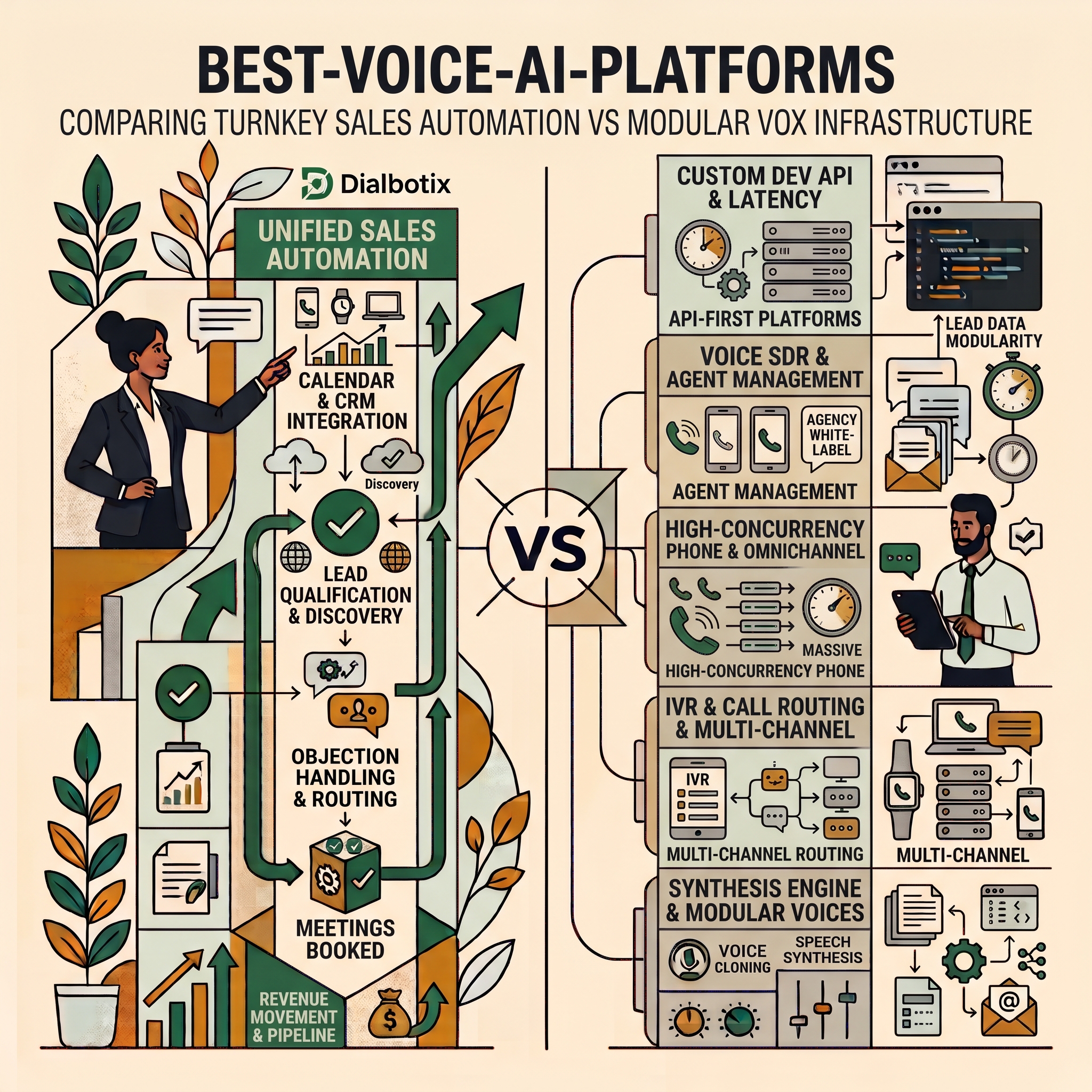
The voice AI market now includes several distinct types of platforms. Some provide developer infrastructure and APIs, some offer no-code agent builders, some focus on highly realistic voices, and others package voice automation into complete business or contact-center products.

That distinction is important because a platform with excellent speech synthesis is not automatically the best platform for running a sales campaign. Likewise, a powerful developer API may be a poor fit for a business team that wants to configure an agent without writing code.

The best platform therefore depends on what you are actually building. A developer creating a custom voice application may prioritize APIs, model flexibility, latency, and telephony control. A sales team may care more about campaigns, qualification, booking, CRM synchronization, and deployment speed.

This comparison evaluates leading platforms across voice quality, conversational performance, telephony, agent building, integrations, outbound capabilities, business workflows, scalability, ease of deployment, and pricing.

Who it's for

Who should use a voice AI platform?

Voice AI platforms are useful for businesses and developers that need real-time spoken conversations to perform tasks that would otherwise require human phone or voice interactions.

Developers

Build custom voice applications with APIs, SDKs, model controls, telephony integrations, and programmable tools.

Sales teams

Automate outbound prospecting, lead qualification, follow-up, appointment setting, and other repetitive sales conversations.

Customer support teams

Automate common inbound questions, call routing, information collection, and defined support workflows.

Appointment-based businesses

Use conversational agents to answer inquiries, qualify callers, schedule appointments, and send reminders.

Enterprise contact centers

Automate high-volume customer conversations while integrating AI with existing telephony, CRM, and contact-center infrastructure.

Agencies

Build and deploy voice agents for multiple clients using reusable workflows and integrations.

Methodology

How we evaluate voice AI platforms

Voice quality is only one part of a production voice AI system. We evaluate platforms based on the complete experience from building an agent to running and measuring real conversations.

  1. 01

    Voice quality

    Natural pronunciation, expressive speech, conversational pacing, voice selection, and overall realism.

  2. 02

    Conversation quality

    Context retention, interruption handling, turn-taking, objection handling, and the ability to manage unexpected responses.

  3. 03

    Latency

    How quickly the system responds during live conversations and whether delays make the interaction feel unnatural.

  4. 04

    Agent building

    Availability of no-code builders, APIs, SDKs, prompts, workflows, tools, and controls for creating production agents.

  5. 05

    Telephony

    Phone numbers, SIP, carrier connectivity, inbound and outbound calls, routing, transfers, and telephony flexibility.

  6. 06

    Outbound calling

    Campaign management, automated dialing, calling lists, concurrency, scheduling, and outbound workflow support.

  7. 07

    Integrations

    CRM, calendar, API, webhook, database, business application, and custom integration capabilities.

  8. 08

    Business workflows

    Ability to move beyond conversation into actions such as qualification, booking, routing, CRM updates, and follow-up.

  9. 09

    Scalability

    Concurrency, reliability, monitoring, observability, call volume, and operational controls at production scale.

  10. 10

    Pricing

    Total cost including platform fees, minutes, model usage, telephony, integrations, and enterprise commitments.

At a glance

Best voice AI platforms compared

The platforms below represent different approaches to voice AI, from complete no-code business products to developer infrastructure, voice-first platforms, and enterprise conversational AI systems.

DialbotixThis one

$79/mo+

Voice AI
Lead Qualification
Native
Booking
Native
CRM
Native + API
Outbound
Core
Retell AI

Usage-based

Voice AI
Lead Qualification
Custom
Booking
Custom
CRM
API / integrations
Outbound
Vapi

Usage-based

Voice AI
Lead Qualification
Custom
Booking
Custom
CRM
API
Outbound
ElevenLabs

Subscription + usage

Voice AI
Lead Qualification
Custom
Booking
Custom
CRM
API / integrations
Outbound
Custom
Synthflow

Subscription + usage

Voice AI
Lead Qualification
Booking
CRM
Integrations
Outbound
Bland AI

Usage-based

Voice AI
Lead Qualification
Custom
Booking
Custom
CRM
API
Outbound
Strong
PolyAI

Custom

Voice AI
Lead Qualification
Booking
Custom
CRM
Enterprise
Outbound
Limited
Twilio

Usage-based

Voice AI
Lead Qualification
Custom
Booking
Custom
CRM
API
Outbound
IncludedNot available
Verdict

The best voice AI platforms ranked

The right voice AI platform depends on whether you need a complete business solution, developer infrastructure, voice quality, no-code deployment, outbound automation, or enterprise contact-center capabilities.

1

Dialbotix

Best for no-code sales voice AI

Dialbotix is a no-code AI voice agent platform designed to turn phone conversations into complete sales workflows. Businesses can set up a voice agent in about two minutes without writing code, connect leads, launch campaigns, qualify prospects, book meetings, and synchronize results with their CRM.

Why it ranks here — Dialbotix ranks first for businesses looking for a complete, immediately deployable voice AI system for sales and outbound workflows rather than a collection of infrastructure components. It combines AI calling with qualification, campaign management, appointment booking, CRM sync, transcripts, monitoring, and analytics.

Strengths
  • No-code voice agent setup
  • Designed for business users
  • Outbound sales automation
  • Native lead qualification
  • Automatic meeting booking
  • Campaign management
  • CRM synchronization
  • Webhooks and REST API
  • Live call monitoring
  • Call transcripts, summaries, and analytics
Trade-offs
  • More specialized around sales and lead workflows than general-purpose voice infrastructure
  • Developers requiring granular control over every voice component may prefer infrastructure-first platforms
Pricing

Starter begins at $79/month with 300 AI calling minutes, followed by Growth at $149/month with 800 minutes and Scale at $299/month with 2,000 minutes. Pay-as-you-go calling is also available.

Best for

Sales teams, startups, agencies, and businesses that want to deploy production voice AI without building the underlying voice stack.

2

Retell AI

Best for production voice infrastructure

Retell AI provides voice agent infrastructure for building production-grade inbound and outbound phone agents through no-code tools and developer interfaces.

Why it ranks here — Retell is a strong choice for teams that want a mature voice-agent layer with control over production conversations and integrations. It is especially attractive to teams that are comfortable assembling their own business workflow around the voice platform.

Strengths
  • Strong real-time conversation experience
  • Inbound and outbound calls
  • No-code and developer options
  • Production testing
  • API and SDK support
  • Monitoring and analytics
Trade-offs
  • Not specifically a sales operating system
  • More surrounding workflow may need to be built or integrated separately
Pricing

Primarily usage-based, with the final cost depending on configuration and selected voice, model, and telephony components.

Best for

Engineering-led businesses building production voice applications.

3

Vapi

Best for developer flexibility

Vapi is a developer-focused voice AI platform that gives engineering teams control over models, tools, providers, telephony, and application logic.

Why it ranks here — Vapi is particularly strong for teams that want to compose their own voice stack rather than adopt a heavily opinionated business application.

Strengths
  • API-first architecture
  • High developer flexibility
  • Model and provider choice
  • Custom tools
  • Programmable workflows
  • Inbound and outbound calling
Trade-offs
  • Requires engineering resources
  • More business workflow components need to be assembled separately
Pricing

Usage-based with the total cost depending on models, speech services, telephony, and configuration.

Best for

Developers and engineering teams building customized voice applications.

4

ElevenLabs

Best for voice quality

ElevenLabs combines highly realistic speech technology with conversational AI capabilities for voice applications and agents.

Why it ranks here — ElevenLabs is particularly compelling when natural and expressive speech is one of the most important requirements. Its voice technology is a major differentiator, although businesses may still need additional systems for complete operational workflows.

Strengths
  • High-quality synthetic voices
  • Strong voice customization
  • Conversational AI
  • Multilingual capabilities
  • Developer APIs
  • Voice-focused product ecosystem
Trade-offs
  • Voice capability does not automatically provide a complete sales or CRM workflow
  • Additional integrations may be required for business automation
Pricing

Subscription and usage-based pricing depending on the selected products and consumption.

Best for

Teams prioritizing voice realism and voice-first conversational experiences.

5

Synthflow

Best for no-code general voice automation

Synthflow is a visual no-code platform for building AI voice agents without requiring traditional software development.

Why it ranks here — Synthflow is a strong fit for teams that value visual workflow design and want to deploy general-purpose phone agents quickly.

Strengths
  • No-code builder
  • Visual workflows
  • Inbound and outbound calling
  • Calendar integrations
  • Agency workflows
  • Business integrations
Trade-offs
  • Less specifically focused on sales operations than Dialbotix
  • Pricing and production economics can vary substantially with usage
Pricing

Pricing varies by deployment and usage, with subscription and usage components.

Best for

Non-technical teams and agencies building general-purpose voice workflows.

6

Bland AI

Best for high-volume phone automation

Bland AI provides programmable AI phone agents with a strong emphasis on automated inbound and outbound calling.

Why it ranks here — Bland is particularly relevant for organizations that need large-scale phone automation and want a platform designed around calling rather than general conversational interfaces.

Strengths
  • High-volume calling
  • Outbound automation
  • Programmable agents
  • Workflow controls
  • API access
  • Campaign-oriented use cases
Trade-offs
  • More infrastructure/workflow oriented than a complete sales application
  • Additional systems may be needed for sophisticated CRM and sales operations
Pricing

Usage-based pricing with platform and calling economics varying by plan and deployment.

Best for

Organizations running large automated phone campaigns.

7

PolyAI

Best for enterprise contact centers

PolyAI provides enterprise conversational voice automation designed primarily for customer-service and contact-center environments.

Why it ranks here — PolyAI is a strong choice for large organizations where contact-center automation, complex customer conversations, and enterprise deployment requirements matter more than self-serve setup.

Strengths
  • Enterprise conversational AI
  • Contact-center focus
  • Complex customer conversations
  • Large-scale deployments
  • Enterprise integrations
Trade-offs
  • Enterprise sales process
  • Custom pricing
  • More implementation overhead
  • Not primarily designed for SMB outbound sales
Pricing

Custom enterprise pricing.

Best for

Large enterprises automating customer-service and contact-center conversations.

8

Twilio

Best for communications infrastructure

Twilio provides programmable communications infrastructure that developers can use as the foundation for custom voice AI applications.

Why it ranks here — Twilio is a powerful option when communications infrastructure and deep programmability are more important than having a packaged AI voice agent product.

Strengths
  • Extensive telephony infrastructure
  • Programmable voice
  • Global communications capabilities
  • APIs and SDKs
  • Large developer ecosystem
  • Voice and messaging products
Trade-offs
  • More engineering required
  • AI agent functionality may require assembling multiple components
  • Not a turnkey sales voice agent
Pricing

Usage-based communications pricing with additional costs depending on the AI and application stack.

Best for

Engineering teams already using Twilio or building custom communications applications.

Deep dive

Voice AI platforms: detailed comparison

Dialbotix vs Retell AI

Compare a no-code sales-focused voice AI platform with Retell's production voice infrastructure.

Dialbotix vs Vapi

Compare a business-ready no-code voice platform with Vapi's developer-first architecture.

Dialbotix vs ElevenLabs

Compare complete sales workflows with ElevenLabs' voice-focused conversational AI platform.

Dialbotix vs Synthflow

Compare two no-code voice approaches with different strengths across sales workflows and general automation.

Dialbotix vs Bland AI

Compare sales automation with Bland's high-volume programmable phone calling.

Dialbotix vs PolyAI

Compare SMB sales automation with enterprise contact-center voice automation.

Best AI voice agents

Compare leading platforms specifically focused on conversational AI voice agents.

Best AI phone agents

Compare platforms designed to make and receive real-world phone calls.

Best AI calling platforms

Compare AI platforms for automated inbound and outbound business calling.

Best AI sales agents

Compare AI agents designed to automate prospecting, qualification, follow-up, and sales workflows.

Best AI appointment setters

Compare AI platforms that turn conversations into qualified and scheduled meetings.

Best AI lead qualification software

Compare platforms that automate qualification and identify high-intent prospects.

Decision guide

How to choose a voice AI platform

Choose the platform based on who will build the agent, what the agent needs to accomplish, and how much of the underlying infrastructure you want to own.

01

Define your use case

Decide whether the primary application is sales, customer support, appointment booking, inbound answering, outbound calling, or a custom voice application.

02

Choose your build model

No-code platforms are best when business teams need to deploy quickly. Developer platforms are better when engineers need control over models, infrastructure, tools, and application logic.

03

Evaluate real conversations

Test interruptions, silence, accents, unclear responses, objections, context switching, long calls, and unexpected questions instead of relying only on scripted demos.

04

Check telephony requirements

Verify whether the platform provides phone numbers, SIP, carrier connectivity, inbound and outbound calling, call transfers, recording, and the geographic coverage you need.

05

Model total cost

Calculate the complete cost of voice models, language models, speech recognition, telephony, platform subscriptions, concurrency, integrations, and engineering.

06

Measure business outcomes

Evaluate the system using metrics that matter to your workflow, such as qualified leads, booked meetings, resolution rate, containment, transfer rate, cost per outcome, and human time saved.

Use cases

What can voice AI platforms be used for?

Voice AI can support everything from custom developer applications to complete sales and customer-service workflows.

Outbound sales

Automatically call leads, introduce an offer, qualify prospects, handle common objections, and route qualified opportunities to sales representatives.

Lead qualification

Use conversational questions to determine fit, intent, timing, requirements, and other qualification criteria.

Appointment booking

Connect conversations with calendars so an AI agent can schedule meetings without requiring a human to complete the final step.

Customer support

Answer repetitive customer questions, retrieve information, collect details, and escalate conversations when necessary.

Inbound call handling

Answer business calls, identify intent, provide information, and route callers to the appropriate destination.

Appointment reminders

Automatically call customers to confirm appointments, collect responses, and handle simple rescheduling requests.

Lead reactivation

Reconnect with dormant leads and determine whether previously inactive prospects are now ready for a sales conversation.

Custom voice applications

Develop specialized voice experiences using APIs, SDKs, tools, databases, and custom business logic.

Contact-center automation

Automate high-volume customer interactions while transferring complex or sensitive conversations to human agents.

Pricing

How much do voice AI platforms cost?

Voice AI pricing is difficult to compare because different platforms include different parts of the technology stack. A quoted per-minute rate may cover only orchestration while speech, language models, and telephony are billed separately.

Dialbotix pricing

Dialbotix currently offers Starter at $79/month with 300 AI calling minutes, Growth at $149/month with 800 minutes, and Scale at $299/month with 2,000 minutes. Pay-as-you-go calling is available at $0.25 per call minute, with a 14-day free trial.

See full pricing
What affects total cost
Monthly platform subscriptionIncluded voice minutesAdditional calling minutesSpeech-to-text usageLanguage model usageText-to-speech usageTelephony and phone numbersConcurrent call limitsCRM and third-party integrationsAPI and webhook usageEnterprise supportImplementation and engineering costs

Never compare voice AI platforms using headline per-minute pricing alone. Two platforms can advertise similar rates while including very different components. Calculate the actual cost of a complete production call at your expected volume.

FAQ

Voice AI platforms FAQ

What is a voice AI platform?

A voice AI platform provides the technology needed to create conversational systems that listen to spoken language, understand it, generate responses, and speak back in real time. Depending on the product, it may include voice models, language models, telephony, agent builders, APIs, and business integrations.

What is the best voice AI platform in 2026?

There is no universal winner. Dialbotix is particularly strong for no-code sales and outbound workflows, Retell and Vapi are strong for production and developer-controlled voice applications, ElevenLabs is especially strong for voice quality, Synthflow is strong for no-code general-purpose workflows, and PolyAI is designed for enterprise contact centers.

What is the difference between a voice AI platform and a voice AI API?

A voice AI API generally provides programmable building blocks for developers. A broader voice AI platform may include the API plus agent builders, telephony, testing, monitoring, analytics, integrations, and deployment tools.

Can voice AI platforms make phone calls?

Yes. Many voice AI platforms support outbound phone calls, although the telephony model differs. Some provide phone infrastructure directly, some integrate with telephony providers, and others require businesses to bring their own numbers or carrier setup.

Can voice AI platforms answer phone calls?

Yes. Platforms with inbound telephony can answer calls, understand caller intent, provide information, collect data, route callers, and execute defined workflows.

Can voice AI platforms qualify leads?

Yes. Voice agents can ask qualification questions, understand natural-language answers, identify buying intent, collect structured information, and route qualified prospects to sales teams.

Can voice AI platforms book appointments?

Yes. Platforms with calendar integrations can connect conversations to scheduling systems and allow agents to book meetings during a phone call.

Do voice AI platforms require coding?

It depends on the platform. No-code products such as Dialbotix and Synthflow are designed for business users, while platforms such as Vapi and other APIs provide more developer control and typically require engineering work.

Which voice AI platform has the best voice quality?

Voice quality is subjective and depends on the selected model, language, voice, latency, telephony, and conversation design. ElevenLabs is widely recognized for highly realistic synthetic voices, while other platforms optimize more heavily for complete phone-agent workflows.

How much do voice AI platforms cost?

Pricing ranges from free development tiers and usage-based APIs to monthly subscriptions and custom enterprise contracts. The real cost can include platform fees, speech processing, language models, voice generation, telephony, phone numbers, and integrations.

What should I look for in a voice AI platform?

Evaluate voice quality, latency, conversation reliability, telephony, inbound and outbound support, integrations, agent-building experience, monitoring, scalability, security requirements, pricing, and how much engineering work is required.

Are voice AI platforms suitable for sales?

Yes. Sales is one of the strongest applications for voice AI because agents can automate repetitive prospecting, qualification, follow-up, and appointment-setting conversations while human representatives focus on higher-value opportunities.

Can voice AI platforms integrate with CRMs?

Many support native CRM integrations, APIs, webhooks, or custom integrations. The important distinction is how deeply the platform can synchronize contacts, call outcomes, transcripts, qualification data, and appointments.

Can voice AI replace human customer-service agents?

Voice AI can automate a significant portion of repetitive customer interactions, but it is not a universal replacement for human agents. Complex, sensitive, emotional, or ambiguous conversations often still benefit from human judgment and escalation.

What is the difference between AI voice agents and traditional IVR?

Traditional IVR generally relies on fixed menus and keypad or speech commands. AI voice agents can understand more natural language, maintain conversational context, call tools, and complete multi-step tasks dynamically.

How should I test a voice AI platform before buying?

Run realistic calls rather than scripted demos. Test interruptions, silence, unclear answers, objections, incorrect information, transfers, calendar actions, CRM updates, long conversations, and failure scenarios. Measure actual business outcomes and total cost.

Build your voice AI workflow without the engineering overhead

Set up a no-code AI voice agent in about two minutes, connect your leads, automate conversations, qualify prospects, book meetings, and keep your CRM updated.