All comparisons
Dialbotix vs Vapi

Dialbotix vs Vapi for Sales

Dialbotix and Vapi both enable AI-powered voice conversations, but they target different layers of the stack. Vapi is a developer-first platform for building and deploying voice agents. Dialbotix is purpose-built around outbound sales, combining AI voice calling with lead qualification, appointment booking, CRM updates, and campaign management.

Overview
Dialbotix vs Vapi: what is the difference?

Dialbotix vs Vapi: what is the difference?

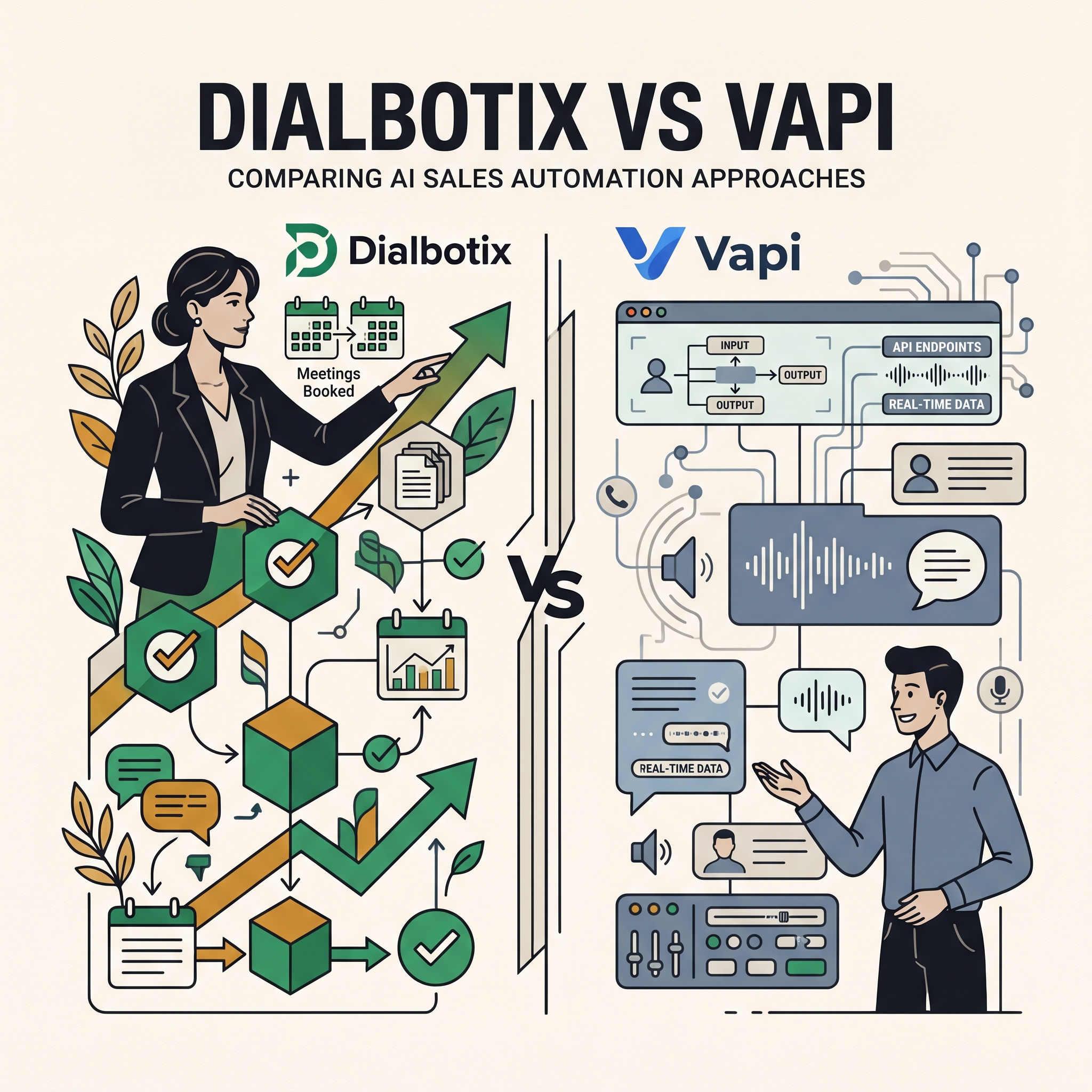
The biggest difference is the level of abstraction. Vapi gives developers infrastructure and tooling to build voice agents. Dialbotix packages AI voice calling into a complete outbound sales workflow so sales teams can focus on campaigns, conversations, qualification, and meetings rather than assembling the underlying system.

Vapi is designed for developers and product teams that want to build voice agents into their own applications. Its developer-first approach provides flexibility around models, voice providers, tools, APIs, and application architecture.

Dialbotix takes a more opinionated approach. It is designed around the specific operational problem of contacting leads, holding qualification conversations, identifying intent, booking meetings, and updating sales systems.

That distinction matters when evaluating the two products. Vapi can be a strong foundation for a custom voice application. Dialbotix is designed to be the finished outbound sales system rather than simply one component inside a system that your team needs to build.

Who it's for

Who is each platform best for?

Both platforms can power AI voice agents, but the ideal buyer and implementation model are different.

Dialbotix for sales teams

Best for sales teams that want AI voice agents to call leads, qualify prospects, book meetings, and synchronize outcomes with their CRM.

Dialbotix for agencies

Best for appointment-setting and lead-generation agencies that need repeatable outbound calling campaigns across multiple lead lists and clients.

Vapi for developers

Best for developers who want flexible infrastructure for building custom voice agents and embedding conversational calling into their own applications.

Vapi for custom workflows

Best for teams that need detailed control over models, providers, tools, application logic, and the architecture surrounding their voice agent.

Dialbotix for outbound calling

Best when the primary business objective is turning lead lists into qualified opportunities and booked appointments through automated phone conversations.

Methodology

How we compare Dialbotix and Vapi

A voice agent platform should be evaluated based on the complete workflow required in production, not simply whether it can place or receive an AI-powered phone call.

  1. 01

    Voice AI

    Can the platform conduct real-time conversations and respond dynamically to prospect responses?

  2. 02

    Lead qualification

    Can the system ask structured qualification questions, interpret answers, and determine lead outcomes?

  3. 03

    Appointment booking

    Can a qualified prospect move directly from conversation to a confirmed calendar appointment?

  4. 04

    CRM connectivity

    Can lead information, call outcomes, transcripts, recordings, and appointments flow back into the CRM?

  5. 05

    Outbound execution

    Can teams launch and manage repeatable outbound calling campaigns against lead lists?

  6. 06

    Developer flexibility

    How much control does the platform provide over models, voice providers, tools, APIs, and custom application logic?

  7. 07

    Time to deployment

    How much additional engineering is required to turn the platform into a production-ready sales workflow?

At a glance

Dialbotix vs Vapi: quick comparison

Vapi is optimized for developers building custom voice applications. Dialbotix is optimized for teams that want a complete outbound sales workflow around AI voice calling.

DialbotixThis one

From $79/mo

Voice AI
Lead Qualification
Built in
Booking
Built in
CRM
HubSpot, Salesforce, webhooks, API
Outbound
Purpose-built
Vapi

Usage-based

Voice AI
Lead Qualification
Configurable
Booking
Configurable
CRM
API / integrations
Outbound
Configurable
IncludedNot available
Verdict

Dialbotix vs Vapi: which is better for sales?

The better platform depends on whether you want to build the voice application yourself or deploy a sales-specific system. Dialbotix ranks higher for teams looking for outbound sales execution. Vapi ranks highly for developers who prioritize infrastructure flexibility and custom implementation.

1

Dialbotix

Best for outbound sales

Dialbotix combines AI voice calling with lead management, qualification, appointment booking, CRM synchronization, campaign management, transcripts, recordings, summaries, and analytics.

Why it ranks here — Dialbotix is designed around the complete sales workflow. Instead of requiring a team to construct lead management, sales qualification, appointment scheduling, CRM workflows, and campaign operations around voice infrastructure, these functions are part of the product's intended workflow.

Strengths
  • Purpose-built for outbound sales
  • AI voice calling
  • Lead qualification
  • Automatic appointment booking
  • HubSpot integration
  • Salesforce integration
  • CSV lead imports
  • Webhooks and API
  • Campaign management
  • Automatic retries
  • Live call monitoring
  • Live transcripts
  • Call recordings
  • AI call summaries
  • Call analytics
Trade-offs
  • More opinionated than developer-first voice infrastructure
  • Less suited to completely custom voice applications outside sales
  • Teams seeking low-level application control may prefer a developer platform
Pricing

Dialbotix currently starts at $79/month for 300 AI calling minutes. Growth is $149/month for 800 minutes and Scale is $299/month for 2,000 minutes. Pay-as-you-go is also available.

Best for

Sales teams, appointment-setting agencies, lead-generation companies, real estate teams, and businesses that want to deploy outbound AI voice agents without building the complete sales workflow from scratch.

2

Vapi

Best for developers

Vapi is a developer-focused voice AI platform designed to help teams build, deploy, and integrate voice agents into custom applications and workflows.

Why it ranks here — Vapi provides flexibility that can be valuable when developers want control over the underlying voice-agent architecture. For a complete outbound sales deployment, however, teams may need to build additional layers for lead management, qualification workflows, campaign operations, scheduling, and CRM processes.

Strengths
  • Developer-first architecture
  • AI voice agents
  • APIs
  • Custom tools
  • Flexible integrations
  • Custom application workflows
  • Model and provider flexibility
  • Real-time conversational applications
Trade-offs
  • Requires more implementation for a complete sales workflow
  • Sales-specific campaign management is not the primary abstraction
  • Appointment booking requires workflow configuration
  • CRM workflows require integration
  • Lead management may require additional application infrastructure
  • Engineering effort can increase as the sales workflow becomes more complex
Pricing

Vapi uses usage-based pricing and infrastructure costs can depend on the models, voice providers, telephony, and other services used in a deployment.

Best for

Developers, startups, product teams, and engineering organizations building custom AI voice applications or needing control over the underlying voice-agent stack.

Deep dive

Detailed Dialbotix vs Vapi comparison

Voice AI

Both platforms support AI-powered voice conversations. The difference is how that capability is packaged. Vapi exposes voice-agent infrastructure for developers, while Dialbotix packages voice into a sales-specific product workflow.

Developer flexibility

Vapi has a clear advantage when developers need low-level control and want to construct their own application architecture around voice agents. Dialbotix is intentionally more opinionated because it is designed to solve a specific operational sales problem.

Outbound calling

Dialbotix is built around outbound lead calling and campaign execution. Vapi can support outbound calling applications, but the surrounding lead and campaign management experience depends more heavily on the implementation built around the platform.

Lead qualification

Dialbotix treats qualification as a core sales function. Vapi gives developers the tools to implement conversational qualification, but the qualification framework, lead states, business rules, and CRM workflows are determined by the application.

Appointment booking

Dialbotix connects conversational qualification to appointment booking as part of the sales workflow. With Vapi, teams can build appointment scheduling into the agent by connecting calendars, tools, and application logic.

CRM integration

Dialbotix is designed around CRM-driven outbound sales and supports HubSpot, Salesforce, CSV imports, webhooks, and APIs. Vapi provides developer tooling that can be connected to CRM systems through custom integrations and application logic.

Campaign management

Campaign management is a central concept in Dialbotix. Vapi is primarily a voice-agent infrastructure layer, so campaign orchestration and sales operations generally need to be implemented by the development team or surrounding systems.

Customization

Vapi is better suited to highly customized voice applications where developers want control over the architecture. Dialbotix provides customization within an opinionated outbound sales environment.

Time to deployment

Dialbotix is designed to shorten the path from lead data to an active outbound sales campaign. Vapi can significantly accelerate custom voice-agent development, but the total implementation time depends on how much sales infrastructure must be built around the voice layer.

Total implementation effort

The difference becomes more important as the workflow grows. A simple voice agent can be relatively straightforward to build on developer infrastructure. A production sales system requires lead management, qualification, scheduling, CRM synchronization, analytics, retries, monitoring, and campaign controls.

Who should choose Dialbotix?

Choose Dialbotix when your primary objective is outbound sales, lead qualification, appointment setting, CRM synchronization, and campaign execution through AI voice agents.

Who should choose Vapi?

Choose Vapi when your team wants developer-first infrastructure and expects to build a custom voice-agent application with its own workflows, interfaces, integrations, and business logic.

Decision guide

How to choose between Dialbotix and Vapi

The simplest way to decide is to determine whether you need a sales product or a voice-agent development platform.

01

Decide whether you want to build or deploy

If your team wants to build a custom voice application, Vapi provides a developer-focused foundation. If your objective is to deploy an outbound sales workflow, Dialbotix removes much of the application assembly required around the voice agent.

02

Map your sales workflow

List every step from lead import to final outcome: calling, qualification, follow-up, booking, CRM updates, transcripts, recordings, and reporting. The more of these functions you need out of the box, the stronger the case for a sales-specific platform.

03

Evaluate engineering capacity

Consider whether your team wants to own the engineering required to connect telephony, voice AI, lead data, CRM systems, calendars, business rules, analytics, and campaign management.

04

Define qualification requirements

Document the questions, qualification criteria, disqualifiers, and lead outcomes your agent must handle. This shows how much sales-specific logic needs to be implemented around the conversational layer.

05

Map the appointment workflow

Determine what should happen after a prospect expresses interest. A real appointment workflow needs calendar availability, confirmation, CRM updates, and reliable handling of the final booking state.

06

Calculate total cost of ownership

Compare more than the voice usage rate. Include telephony, model usage, integrations, engineering, hosting, monitoring, CRM infrastructure, calendar integrations, campaign management, and ongoing maintenance.

Use cases

Dialbotix vs Vapi use cases

Both platforms can support voice agents, but the surrounding implementation is where their intended use cases diverge.

Pricing

Dialbotix vs Vapi pricing

The pricing models reflect the different product layers. Dialbotix packages AI calling into a sales platform, while Vapi follows a usage-based infrastructure model where the total cost can depend on the components used in the deployment.

Dialbotix pricing

Dialbotix currently starts at $79/month for 300 AI calling minutes. Growth is $149/month for 800 minutes, while Scale is $299/month for 2,000 minutes. Pay-as-you-go is also available for variable calling volume.

See full pricing
What affects total cost
Monthly platform feeIncluded AI calling minutesAdditional calling minutesAI model usageVoice provider costsTelephonyCalendar integrationsCRM integrationsAPI usageWebhook usageConcurrencyCampaign managementMonitoring and analyticsEngineering implementationInfrastructure maintenance

Do not compare a developer-focused voice infrastructure rate directly with the price of a complete sales platform. If your team builds the sales workflow around Vapi, include the engineering and operational costs of lead management, qualification, scheduling, CRM synchronization, campaign management, monitoring, and maintenance.

FAQ

Dialbotix vs Vapi FAQs

What is the main difference between Dialbotix and Vapi?

Vapi is a developer-first platform for building and deploying AI voice agents. Dialbotix is purpose-built for outbound sales and combines voice calling with lead qualification, appointment booking, CRM workflows, campaign management, and sales analytics.

Is Vapi an AI voice agent platform?

Yes. Vapi provides infrastructure and developer tooling for building AI voice agents and conversational applications.

Which is better for outbound sales, Dialbotix or Vapi?

Dialbotix is the more direct fit for outbound sales because the product is structured around lead calling, qualification, appointment booking, CRM updates, and campaign execution.

Can Vapi make outbound phone calls?

Vapi can be used to build voice applications that make and handle phone calls. The surrounding campaign, lead management, CRM, and sales workflow depends on how the application is implemented.

Can Vapi qualify sales leads?

Yes. Developers can build qualification logic into a Vapi voice agent. The specific questions, qualification rules, lead states, CRM updates, and business processes are determined by the implementation.

Can Vapi book appointments?

Yes, appointment booking can be implemented by connecting the agent to a calendar or scheduling system and providing the appropriate tools and business logic. Dialbotix provides appointment booking as part of its sales workflow.

Is Vapi better for developers?

Vapi can be the better choice when developers want a flexible foundation for building custom voice applications. Dialbotix is more suitable when the desired application is specifically an outbound sales system.

Is Dialbotix easier to deploy than Vapi?

For an outbound sales use case, Dialbotix can provide a more direct deployment path because lead management, qualification, appointment booking, CRM connectivity, and campaign workflows are part of the product. Vapi provides the underlying developer tooling, so implementation requirements depend on what the team builds around it.

Can Dialbotix integrate with HubSpot?

Yes. Dialbotix supports HubSpot integration along with Salesforce, CSV lead imports, webhooks, and APIs.

Can Dialbotix integrate with Salesforce?

Yes. Salesforce is supported as one of Dialbotix's CRM integrations.

Which is cheaper, Dialbotix or Vapi?

The two products should not be compared solely by their headline usage rates. Dialbotix starts at $79/month for a packaged outbound AI calling product, while Vapi's total usage cost depends on the voice, models, telephony, and other services used by the implementation.

Can I build my own AI voice SDR with Vapi?

Yes, Vapi can be used as infrastructure for building a custom sales voice agent. The team would need to implement or integrate the surrounding lead management, qualification, campaign, scheduling, CRM, and reporting workflows.

Does Dialbotix compete with Vapi?

They overlap in AI voice agents, but their product positioning is different. Vapi is developer-first voice infrastructure, while Dialbotix is a purpose-built outbound sales platform.

Which is better for appointment-setting agencies?

Dialbotix is the more direct fit for appointment-setting agencies because appointment setting, outbound calling, qualification, CRM workflows, and campaign management are central to the product.

Which is better for custom voice applications?

Vapi is generally the stronger fit when a development team needs to build a highly customized voice application and control the surrounding architecture and business logic.

Should I use Vapi or Dialbotix for a sales team with thousands of leads?

If the goal is to operationalize those leads into outbound calling campaigns, qualification, follow-up, and booked meetings, Dialbotix is the more direct product fit. Vapi is better when your team wants to build and own the sales application around voice infrastructure.

Turn outbound calls into qualified meetings

If you need more than voice-agent infrastructure and want an AI voice agent built around outbound sales, Dialbotix connects calling, qualification, appointment booking, CRM updates, and campaign management in one workflow.