All comparisons
Dialbotix vs Synthflow

Dialbotix vs Synthflow for Sales

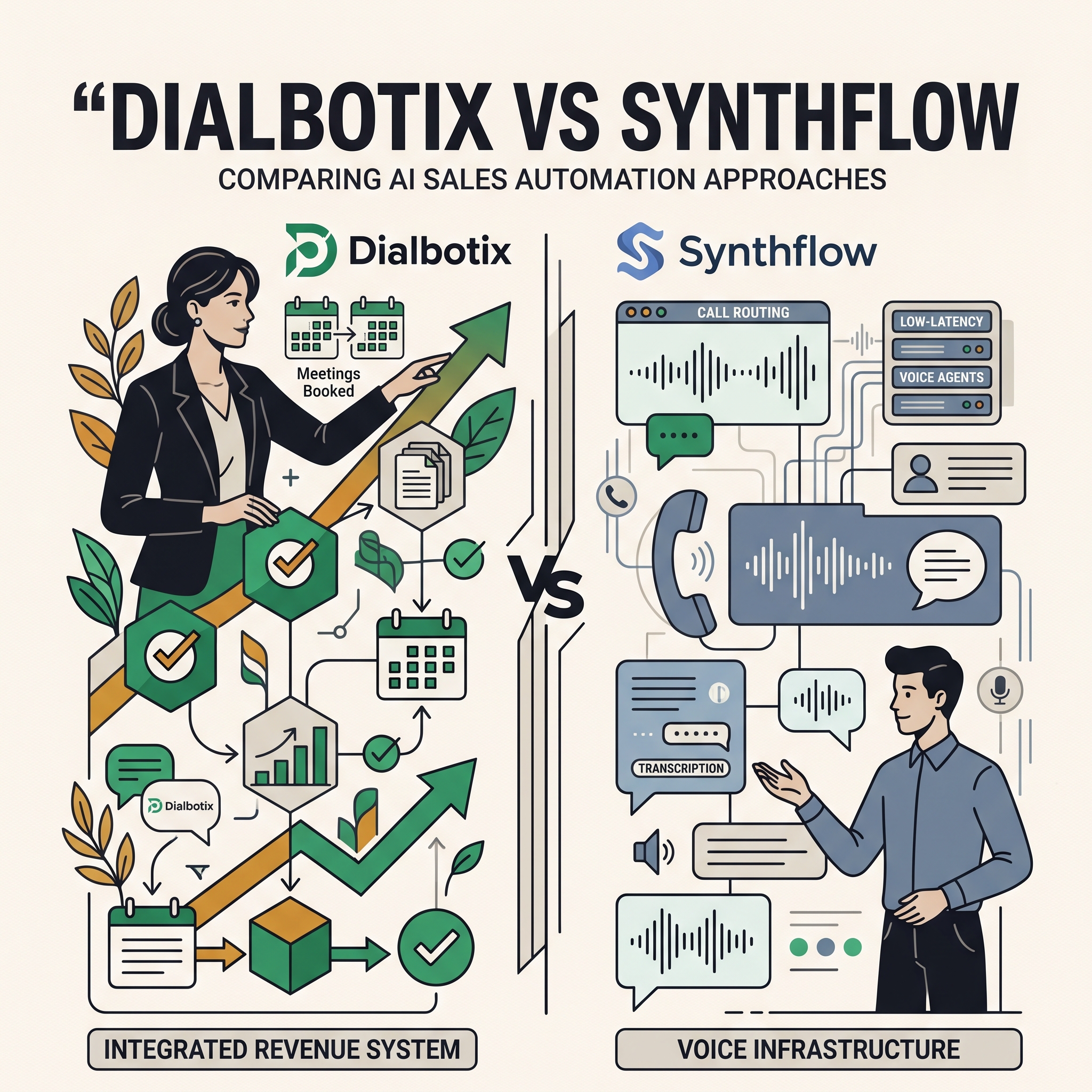
Dialbotix and Synthflow both provide AI voice automation, but they are designed around different priorities. Synthflow is a broad no-code platform for building conversational phone workflows, while Dialbotix is purpose-built around outbound sales, lead qualification, appointment booking, CRM updates, and campaign execution.

Overview
Dialbotix vs Synthflow: what is the difference?

Dialbotix vs Synthflow: what is the difference?

The main difference between Dialbotix and Synthflow is how narrowly each platform is designed around the sales workflow. Synthflow provides a general-purpose environment for creating AI phone agents. Dialbotix focuses specifically on turning outbound leads into qualified conversations and booked meetings.

Synthflow is useful when a business wants to automate many different types of phone interactions without building traditional software. Its broader approach makes it suitable for customer service, inbound calls, outbound workflows, appointment scheduling, and other conversational use cases.

Dialbotix takes a narrower approach because its primary job is sales execution. The platform connects lead lists and campaigns to AI voice conversations, qualification, appointment booking, CRM updates, transcripts, recordings, and campaign analytics.

That distinction matters when choosing between the two. If you need a general voice automation builder, Synthflow can be a strong fit. If the primary objective is outbound sales and appointment setting, Dialbotix is designed around that workflow from the beginning.

Who it's for

Who is each platform best for?

The better platform depends on whether you need broad voice automation or a focused outbound sales system.

Dialbotix for sales teams

Best for sales teams that want AI voice agents to call leads, qualify prospects, book meetings, and push outcomes back into the sales workflow.

Dialbotix for agencies

Best for appointment-setting and lead-generation agencies that need repeatable outbound campaigns across multiple clients.

Synthflow for broad automation

Best for businesses that want to create different types of conversational phone workflows across sales, support, operations, and customer service.

Synthflow for no-code builders

Best for teams that want to visually configure conversational workflows without building a complete voice application from scratch.

Dialbotix for outbound calling

Best when the central problem is a large lead list that needs to be contacted, qualified, followed up with, and converted into appointments.

Methodology

How we compare Dialbotix and Synthflow

A voice platform should not be evaluated only by voice quality or the number of workflow blocks it provides. For outbound sales, the important question is whether the entire process from lead to booked meeting can operate reliably.

  1. 01

    Voice AI

    Can the platform hold a natural real-time phone conversation and respond dynamically to prospect responses?

  2. 02

    Lead qualification

    Can the agent ask qualification questions, interpret answers, and determine whether a lead meets the required criteria?

  3. 03

    Appointment booking

    Can an interested prospect be converted into a confirmed appointment as part of the conversation?

  4. 04

    CRM connectivity

    Can lead data, call outcomes, transcripts, recordings, and appointments flow into the CRM or sales system?

  5. 05

    Outbound execution

    Can the platform manage lead lists, campaigns, calling attempts, and follow-up at useful outbound volume?

  6. 06

    Ease of deployment

    How much configuration is required before a sales team can begin running real campaigns?

  7. 07

    Pricing

    Does the pricing reflect the complete workflow and remain understandable as calling volume increases?

At a glance

Dialbotix vs Synthflow: quick comparison

Both platforms support AI voice automation and can be configured for appointment-related workflows. The key difference is product focus: Dialbotix is centered on outbound sales, while Synthflow is a broader conversational automation platform.

DialbotixThis one

From $79/mo

Voice AI
Lead Qualification
Built in
Booking
Built in
CRM
HubSpot, Salesforce, webhooks, API
Outbound
Purpose-built
Synthflow

Sales-led

Voice AI
Lead Qualification
Configurable
Booking
CRM
Integrations
Outbound
IncludedNot available
Verdict

Dialbotix vs Synthflow: which is better for sales?

Both platforms can automate phone conversations, but they are optimized for different jobs. Dialbotix is the stronger fit when outbound sales and appointment setting are the central requirement. Synthflow is more attractive when the business needs a broader conversational automation platform.

1

Dialbotix

Best for outbound sales and appointment setting

Dialbotix is designed around the sales process from the beginning. It can call leads, conduct qualification conversations, determine lead outcomes, book appointments, update CRM records, and provide transcripts, recordings, summaries, and campaign analytics.

Why it ranks here — The advantage is specialization. A sales team does not need to turn a general voice automation environment into a sales system because the core sales workflow is already part of the product.

Strengths
  • Purpose-built for outbound sales
  • AI voice calling
  • Lead qualification
  • Automatic appointment booking
  • HubSpot integration
  • Salesforce integration
  • CSV lead imports
  • Webhooks and API
  • Campaign management
  • Automatic retries
  • Live call monitoring
  • Live transcripts
  • Call recordings
  • AI call summaries
  • Real-time campaign analytics
Trade-offs
  • More opinionated than a general-purpose voice automation builder
  • Primarily focused on sales rather than every possible phone workflow
  • Businesses with complex non-sales automation requirements may prefer a broader platform
Pricing

Dialbotix currently starts at $79/month for 300 AI calling minutes. Growth is $149/month for 800 minutes and Scale is $299/month for 2,000 minutes. Pay-as-you-go is also available.

Best for

Sales teams, appointment-setting agencies, lead-generation businesses, real estate teams, and companies that want an outbound AI voice agent without building the complete sales workflow themselves.

2

Synthflow

Best for general no-code voice automation

Synthflow is a broad AI voice automation platform that allows businesses to create conversational phone workflows without traditional software development.

Why it ranks here — Synthflow is powerful when voice automation needs extend beyond sales. Its broader scope makes it useful for businesses that want one platform for multiple conversational workflows, although sales-specific workflows require configuration.

Strengths
  • No-code workflow builder
  • AI voice conversations
  • Inbound and outbound workflows
  • Appointment scheduling
  • CRM integrations
  • Automation integrations
  • Broad business use cases
  • Visual workflow configuration
Trade-offs
  • Broader than a dedicated sales platform
  • Sales workflows require configuration
  • Campaign and sales-specific processes may need additional setup
  • Current enterprise pricing is sales-led
Pricing

Synthflow currently uses sales-led pricing for new deployments, with enterprise contracts starting at $30,000 annually.

Best for

Businesses and agencies that need a general-purpose no-code voice automation platform across sales, customer service, support, and other phone workflows.

Deep dive

Detailed Dialbotix vs Synthflow comparison

Voice AI

Both Dialbotix and Synthflow provide AI voice conversations. Synthflow approaches voice as a general automation layer, while Dialbotix packages voice directly into an outbound sales workflow.

Outbound calling

Both platforms can support outbound calls. Dialbotix is specifically structured around outbound lead campaigns, making lead lists, campaigns, qualification, retries, and sales outcomes central to the product.

Lead qualification

Synthflow can be configured for qualification conversations using its workflow system. Dialbotix treats qualification as a core sales function, allowing campaigns to be configured around qualification criteria and lead outcomes.

Appointment booking

Both platforms can support appointment scheduling. Dialbotix makes booking part of the outbound sales sequence: the agent qualifies interest and moves the prospect toward a calendar appointment within the same workflow.

CRM integration

Synthflow provides integrations that allow voice workflows to connect with external systems. Dialbotix is built around CRM-driven sales execution, with HubSpot, Salesforce, webhooks, APIs, and CSV lead sources.

Campaign management

Dialbotix treats campaigns as a core sales object, allowing businesses to manage agents, leads, calling behavior, qualification, retries, and booking workflows together. Synthflow provides flexible workflow construction, but the sales campaign structure is less central to its product positioning.

No-code flexibility

Synthflow has an advantage when a business wants to visually construct many different types of phone workflows. Dialbotix is more opinionated because it prioritizes a repeatable outbound sales process over general-purpose workflow flexibility.

Sales specialization

Dialbotix has the clearer sales specialization. Its product is designed around calling leads, qualifying them, booking meetings, updating sales systems, and analyzing campaign outcomes. Synthflow supports these workflows but also targets many other phone automation use cases.

Time to deployment

Both platforms aim to reduce the engineering required for voice automation. Dialbotix can be more direct for sales teams because the required outbound sales concepts are already modeled into the platform instead of requiring teams to design the entire sales workflow themselves.

Who should choose Dialbotix?

Choose Dialbotix when your main objective is outbound sales: calling leads, qualifying prospects, booking meetings, updating the CRM, and measuring campaign performance.

Who should choose Synthflow?

Choose Synthflow when you want a broader no-code voice automation platform and expect to build different kinds of conversational workflows across sales, customer service, support, operations, or inbound calling.

Decision guide

How to choose between Dialbotix and Synthflow

The right choice depends on whether your business needs a specialized sales system or a broader voice automation environment.

01

Define the primary phone workflow

If the main job is calling leads and booking sales meetings, start with a sales-focused platform. If you expect to automate many unrelated phone workflows, a broader platform may provide more flexibility.

02

Decide how much workflow construction you want

Synthflow gives teams broad control over how conversational workflows are assembled. Dialbotix provides more prebuilt sales structure so teams can focus on campaigns and outcomes instead of designing every component.

03

Map your qualification process

Write down the questions, qualification criteria, disqualifiers, and outcomes your agent needs to handle. Then determine how naturally those rules fit into the platform's workflow model.

04

Check appointment scheduling

Look beyond whether a platform says it supports calendars. Determine whether the AI agent can move from a positive sales conversation to a confirmed appointment without unnecessary manual handoffs.

05

Check CRM and lead sources

Your system should be able to receive leads and return useful outcomes. Consider CRM integrations, CSV imports, APIs, webhooks, transcripts, recordings, and lead-status updates.

06

Calculate the complete operating cost

Include platform fees, calling volume, telephony, AI usage, integrations, implementation work, monitoring, and the human effort needed to operate campaigns when comparing the two platforms.

Use cases

Dialbotix vs Synthflow use cases

Both platforms can be used for phone automation, but Dialbotix is optimized around sales outcomes while Synthflow supports a broader range of conversational business workflows.

Outbound sales prospecting

Use Dialbotix to call lead lists, identify interest, qualify prospects, and schedule sales meetings.

New lead follow-up

Automatically contact new leads while their interest is still fresh and move qualified prospects toward an appointment.

Cold lead reactivation

Reconnect with older CRM leads that were never converted and identify prospects who may still have buying intent.

Appointment booking

Turn a qualified phone conversation into a scheduled meeting using an integrated calendar workflow.

Lead qualification

Use conversational qualification criteria to separate interested and qualified prospects from poor-fit leads.

Appointment-setting agencies

Run repeatable outbound campaigns for multiple clients without scaling human appointment setters linearly with lead volume.

Customer service automation

Synthflow can be a strong fit when the goal extends beyond sales into broader inbound customer service and conversational phone automation.

Custom business phone workflows

Synthflow is suited to teams that want to build different conversational workflows for operations, support, scheduling, and other business processes.

Pricing

Dialbotix vs Synthflow pricing

The pricing models reflect the difference in product scope. Dialbotix packages AI calling around outbound sales plans, while Synthflow uses a broader voice automation model with sales-led pricing for current deployments.

Dialbotix pricing

Dialbotix currently starts at $79/month for 300 AI calling minutes. Growth is $149/month for 800 minutes, while Scale is $299/month for 2,000 minutes. A pay-as-you-go option is also available for teams with variable calling volume.

See full pricing
What affects total cost
Monthly platform feeIncluded AI calling minutesAdditional calling minutesAI model costsVoice generationTelephonyCalendar integrationsCRM integrationsAPI and webhook usageConcurrencyCampaign managementImplementation effortMonitoring and analyticsEnterprise support

Do not compare pricing only by the advertised voice-minute rate. The total cost of an AI voice sales system includes the platform, telephony, AI usage, integrations, workflow configuration, campaign management, and engineering or operational work.

FAQ

Dialbotix vs Synthflow FAQs

What is the main difference between Dialbotix and Synthflow?

Synthflow is a general-purpose no-code AI voice automation platform that can be used for many types of phone workflows. Dialbotix is purpose-built around outbound sales, lead qualification, appointment booking, CRM updates, and campaign management.

Is Synthflow an AI appointment setter?

Synthflow can be configured to perform appointment-setting workflows. However, it is a broader voice automation platform rather than a product focused exclusively on outbound appointment setting.

Which is better for outbound sales, Dialbotix or Synthflow?

Dialbotix is the stronger fit when outbound sales is the primary requirement. Its workflow is specifically structured around lead calling, qualification, appointment booking, CRM updates, and campaign execution.

Can Synthflow make outbound calls?

Yes. Synthflow supports outbound voice workflows. The platform can be configured for calling, qualification, scheduling, and other business processes.

Can Dialbotix qualify leads automatically?

Yes. Dialbotix is designed to qualify leads during AI voice conversations using campaign-specific qualification criteria and produce an actionable lead outcome.

Can both Dialbotix and Synthflow book appointments?

Yes. Both platforms can support appointment-booking workflows. Dialbotix makes appointment booking part of its core outbound sales workflow, while Synthflow provides configurable scheduling workflows as part of its broader automation platform.

Which is better if I want a no-code voice platform?

Synthflow is the stronger choice if broad no-code workflow construction is the main priority. Dialbotix is more specialized and provides more of the sales workflow out of the box.

Which platform is better for appointment-setting agencies?

Dialbotix is designed specifically for outbound appointment-setting workflows, making it a natural fit for agencies that need to run lead campaigns across clients.

Can Dialbotix integrate with HubSpot and Salesforce?

Yes. Dialbotix supports HubSpot and Salesforce connectivity, along with webhooks, APIs, and CSV lead imports.

Does Synthflow work with CRMs?

Yes. Synthflow supports integrations that allow voice workflows to connect with external business systems. The exact implementation depends on the workflow and integration being used.

Is Dialbotix cheaper than Synthflow?

Dialbotix currently has public plans starting at $79/month. Synthflow uses sales-led pricing for current deployments, so a direct price comparison depends on the scope, calling volume, integrations, and deployment requirements.

Can Synthflow replace an appointment setter?

It can automate many appointment-setting tasks, including conversations and scheduling. Whether it replaces a human setter depends on the complexity of the sales process, lead quality, objections, and the amount of human judgment required.

Can Dialbotix call leads from a CSV?

Yes. Dialbotix supports CSV lead imports, allowing imported leads to be used in outbound campaigns.

Which platform should I choose without a development team?

Dialbotix is a strong fit when the business wants an outbound sales workflow without building the application around the voice agent. Synthflow is also designed to reduce development requirements, but provides a broader workflow-building environment.

Which platform is better for non-sales phone automation?

Synthflow is generally the better fit when the requirement includes many different phone workflows outside sales, such as customer service, support, scheduling, and operational automation. Dialbotix is intentionally focused on sales execution.

Turn your lead list into booked meetings

Dialbotix gives sales teams an AI voice agent built around the outbound sales workflow. Call leads, qualify conversations, book meetings, update your CRM, and measure campaign outcomes without building the entire system yourself.