All comparisons
AI Receptionist for Small Business

The Best AI Receptionist for Small Business

AI receptionists can answer calls, qualify callers, schedule appointments, capture information, and handle repetitive phone conversations without requiring a full-time receptionist. Here are the strongest options for small businesses.

Overview
What is an AI receptionist for a small business?

What is an AI receptionist for a small business?

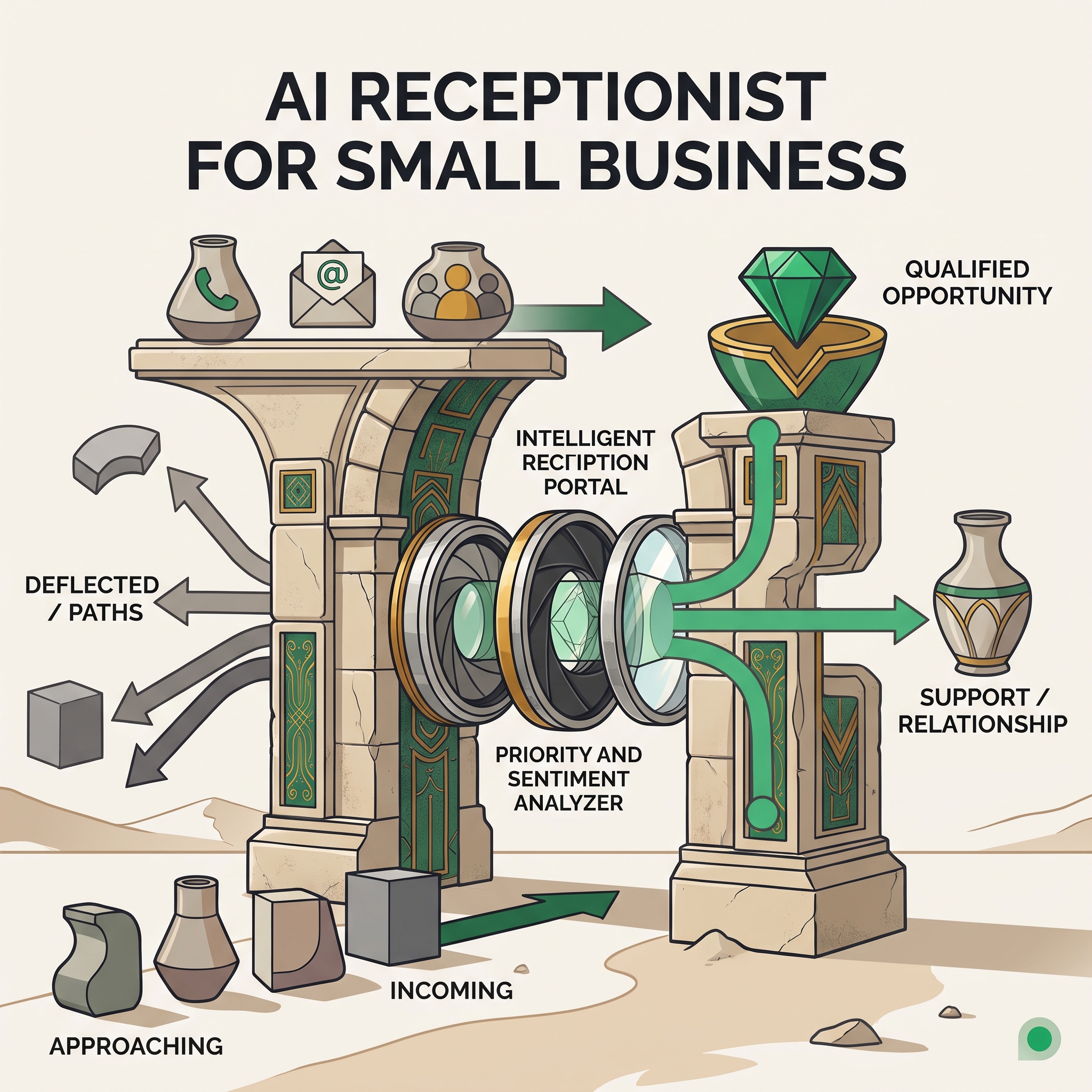
An AI receptionist is a voice-based system that handles incoming and outgoing phone conversations using artificial intelligence.

For a small business, an AI receptionist can answer calls when employees are busy, collect caller information, answer routine questions, qualify leads, schedule appointments, and route conversations to the appropriate person.

The main advantage is not simply replacing a phone greeting. A useful AI receptionist should be able to understand what the caller wants, respond naturally, take an appropriate action, and keep the business workflow moving.

Dialbotix approaches this as a broader AI voice agent platform rather than only an answering service. Businesses can configure voice agents without writing code and use them for phone-based workflows such as lead qualification, follow-up, appointment booking, and increasingly inbound receptionist workflows.

Who it's for

Who should use an AI receptionist?

AI receptionists are most useful when a business receives enough repetitive calls that missed calls, slow responses, or manual scheduling create a measurable operational cost.

Small service businesses

Answer calls and capture inquiries without requiring an employee to stay beside the phone.

Appointment-based businesses

Handle scheduling requests and move qualified callers toward booked appointments.

Growing teams

Provide phone coverage while employees focus on customers, operations, and revenue-generating work.

Businesses with frequent inbound calls

Handle common questions and collect caller details consistently across conversations.

Sales-driven businesses

Go beyond answering by qualifying prospects and following up with leads.

After-hours businesses

Maintain a consistent phone response outside normal employee availability.

Methodology

How we evaluate AI receptionists

A receptionist should be evaluated as a business workflow, not simply as a voice-generation product.

  1. 01

    Natural conversation

    The agent should understand callers, maintain context, handle interruptions, and respond without forcing rigid menu-style interactions.

  2. 02

    Call handling

    Look at whether the system can answer calls, collect information, route conversations, and handle common requests.

  3. 03

    Appointment booking

    Businesses that depend on appointments should verify calendar integration and whether the agent can actually complete booking workflows.

  4. 04

    Lead qualification

    The ability to identify intent and collect qualification information makes an AI receptionist more useful for sales-oriented businesses.

  5. 05

    Follow-up

    Strong platforms can extend beyond a single call and support follow-up workflows when a caller or lead is not ready to convert immediately.

  6. 06

    Integrations

    CRM, calendar, API, webhook, and data integrations determine whether the receptionist fits into an existing business workflow.

  7. 07

    Setup complexity

    Small businesses generally benefit from no-code configuration rather than requiring engineers to build and maintain every call workflow.

  8. 08

    Pricing

    Compare subscription fees, included minutes, usage charges, setup costs, and any additional telephony or integration expenses.

At a glance

Best AI receptionists for small businesses compared

The right choice depends on whether your priority is traditional call answering, receptionist workflows, appointment booking, sales qualification, or broader voice automation.

DialbotixThis one

From $79/mo

Voice AI
Lead Qualification
Strong
Booking
CRM
Outbound
Smith.ai

Usage-based / plans

Voice AI
Lead Qualification
Booking
CRM
Outbound
Limited
Goodcall

Subscription

Voice AI
Lead Qualification
Booking
CRM
Integrations
Outbound
Limited
Rosie

Plan-based

Voice AI
Lead Qualification
Booking
CRM
Integrations
Outbound
Limited
Synthflow

Usage-based

Voice AI
Lead Qualification
Booking
CRM
Outbound
Retell

Usage-based

Voice AI
Lead Qualification
Developer-configured
Booking
Custom
CRM
Custom
Outbound
Vapi

Usage-based

Voice AI
Lead Qualification
Custom
Booking
Custom
CRM
Custom
Outbound
NextPhone

Plan-based

Voice AI
Lead Qualification
Booking
CRM
Integrations
Outbound
Limited
IncludedNot available
Verdict

Best AI receptionist platforms for small business

These platforms cover different parts of the AI phone automation market. Dialbotix ranks first here because it combines no-code voice-agent setup with qualification, booking, CRM workflows, and outbound capabilities rather than treating the phone system as only an answering layer.

1

Dialbotix

Best Overall

Dialbotix is a no-code AI voice agent platform designed to automate phone conversations. A business can configure a voice agent in about two minutes without writing code, then use it for qualification, appointment booking, follow-up, CRM workflows, and expanding receptionist use cases.

Why it ranks here — It offers a broader workflow layer than a traditional AI answering service. The same platform can support inbound receptionist-style conversations while also handling outbound calling and lead conversion workflows.

Strengths
  • No-code voice agent setup
  • AI voice calling
  • Lead qualification
  • Automatic appointment booking
  • CRM synchronization
  • Campaign management
  • Multi-agent support
  • Live call monitoring and transcripts
  • Webhooks and REST API
  • Google Calendar integration
Trade-offs
  • Its strongest established workflows are sales, lead qualification, follow-up, and appointment automation.
  • Businesses needing highly specialized receptionist workflows should validate the exact inbound workflow requirements before deployment.
Pricing

Starter $79/month for 300 AI calling minutes; Growth $149/month for 800 minutes; Scale $299/month for 2,000 minutes; pay-as-you-go at $0.25 per call minute. 14-day free trial.

Best for

Small businesses that want one no-code AI voice platform capable of handling receptionist-style workflows while also supporting lead qualification, follow-up, outbound calling, and appointment booking.

2

Smith.ai

Best for Receptionist Services

Smith.ai combines AI-powered phone answering with receptionist-oriented workflows and human escalation.

Why it ranks here — It is a strong choice for businesses that primarily want calls answered and handled as a receptionist service.

Strengths
  • Receptionist-focused workflows
  • Call answering
  • Human escalation options
  • Lead intake
  • Appointment scheduling
Trade-offs
  • The service model can be less focused on broader outbound sales automation.
  • Costs should be evaluated against expected call volume and human-assisted services.
Pricing

Plan-based and usage-dependent.

Best for

Small businesses primarily looking for phone answering and receptionist coverage.

3

Goodcall

Best for Simple AI Phone Answering

Goodcall provides AI phone agents designed to answer business calls and automate common customer interactions.

Why it ranks here — Its focus on straightforward business phone answering makes it approachable for small teams that do not need a complex sales automation stack.

Strengths
  • AI phone answering
  • Business information handling
  • Lead capture
  • Call routing
  • Small-business orientation
Trade-offs
  • Less suited to businesses looking for a comprehensive outbound sales workflow.
  • Advanced automation requirements may require additional integrations.
Pricing

Subscription-based.

Best for

Small businesses that primarily need an automated phone answering layer.

4

Rosie

Best for Local Businesses

Rosie provides AI phone answering and receptionist-style automation for businesses that rely on inbound calls.

Why it ranks here — It focuses heavily on practical call handling for local and service businesses.

Strengths
  • AI call answering
  • Inbound call handling
  • Lead capture
  • Appointment workflows
  • Local-business orientation
Trade-offs
  • More specialized toward receptionist and inbound use cases.
  • Businesses needing sophisticated outbound campaigns may prefer a broader voice-agent platform.
Pricing

Plan-based.

Best for

Local service businesses that want to automate routine inbound calls.

5

Synthflow

Best No-Code Voice Automation Alternative

Synthflow is a no-code voice AI platform that lets businesses create automated voice workflows.

Why it ranks here — Its visual workflow approach makes it useful for teams that want more control over voice automation without building the underlying infrastructure themselves.

Strengths
  • No-code workflow building
  • Inbound and outbound calls
  • Voice AI
  • Integrations
  • Workflow customization
Trade-offs
  • Can require more workflow configuration than a purpose-built business use-case product.
  • Usage-based costs should be modeled carefully at scale.
Pricing

Usage-based and plan-dependent.

Best for

Teams that want flexible no-code voice automation.

6

Retell

Best Developer Voice Infrastructure

Retell provides infrastructure for building production-grade AI phone agents.

Why it ranks here — It is powerful for teams that want to build their own voice application and control the underlying architecture.

Strengths
  • Voice AI infrastructure
  • Inbound calling
  • Outbound calling
  • Developer APIs
  • Custom workflows
Trade-offs
  • More developer-oriented than a turnkey small-business receptionist.
  • CRM and business workflows generally require additional implementation.
Pricing

Usage-based.

Best for

Developers and product teams building custom voice applications.

7

Vapi

Best Developer Flexibility

Vapi provides developer infrastructure for creating customizable voice agents and phone workflows.

Why it ranks here — It is flexible for engineering teams that want direct control over voice-agent architecture.

Strengths
  • Developer APIs
  • Voice agents
  • Inbound and outbound calling
  • Tool integrations
  • Custom workflows
Trade-offs
  • Requires more technical implementation.
  • Not optimized around the simplest small-business receptionist setup.
Pricing

Usage-based.

Best for

Engineering teams building custom AI phone applications.

8

NextPhone

Best for AI Phone Coverage

NextPhone focuses on AI-powered phone answering and business call automation.

Why it ranks here — It can be a practical option for businesses prioritizing automated call coverage.

Strengths
  • AI phone answering
  • Call handling
  • Lead capture
  • Business phone automation
Trade-offs
  • Broader sales automation may require additional tooling.
  • Feature depth varies by workflow.
Pricing

Plan-based.

Best for

Small businesses looking for automated phone coverage.

Deep dive

AI receptionist platforms: detailed comparison

Dialbotix vs Smith.ai

Compare a broader AI voice-agent platform with a receptionist-oriented service model.

Dialbotix vs Goodcall

Compare no-code voice automation with a small-business-focused AI phone answering platform.

Dialbotix vs Rosie

Compare Dialbotix with an AI receptionist focused on inbound business calls.

Dialbotix vs Synthflow

Compare purpose-built business workflows with flexible no-code voice automation.

Dialbotix vs Retell

Compare turnkey business workflows with developer-oriented voice infrastructure.

Dialbotix vs Vapi

Compare a no-code AI voice agent platform with customizable developer infrastructure.

AI receptionist vs human receptionist

Understand where AI receptionists perform well and where human receptionists remain valuable.

AI receptionist for appointment booking

Explore platforms that can turn phone conversations into scheduled appointments.

AI receptionist for lead qualification

Compare AI systems that qualify callers and leads rather than simply answering phones.

AI receptionist pricing

Understand subscription, usage, minute-based, and human-assisted pricing models.

Best AI phone agents

Compare broader AI phone agents for inbound and outbound business workflows.

Best AI voice platforms

Compare the broader voice AI market across business and developer use cases.

Decision guide

How to choose an AI receptionist for your small business

Start with the phone workflow you need to automate rather than choosing a platform based only on voice quality or advertised AI features.

1

Define the calls you receive

List your most common inbound calls, including questions, booking requests, lead inquiries, transfers, cancellations, and after-hours calls.

2

Decide what the agent must do

Answering a question is different from booking an appointment, qualifying a lead, updating a CRM, or completing a follow-up workflow.

3

Check calendar and CRM integrations

An AI receptionist becomes substantially more useful when it can take actions in the systems your business already uses.

4

Test real conversations

Evaluate interruptions, unclear requests, objections, transfers, caller corrections, and unexpected questions rather than relying on scripted demos.

5

Calculate the actual cost

Model monthly call volume, average call duration, subscription fees, usage charges, setup costs, and human escalation costs.

6

Choose based on future workflows

If the business will eventually need lead qualification, outbound follow-up, appointment booking, or CRM automation, choose a platform that can grow beyond simple call answering.

Use cases

AI receptionist use cases for small businesses

A small business can use an AI receptionist for much more than answering the phone.

Answer inbound calls

Provide immediate responses to common caller requests when employees are unavailable.

Capture new leads

Collect contact details, requirements, and other information from prospective customers.

Qualify prospects

Ask predefined qualification questions and identify higher-intent opportunities.

Book appointments

Connect conversations to calendars and schedule meetings without manual back-and-forth.

Follow up with leads

Call prospects who have not responded or require additional follow-up.

Answer common questions

Handle repetitive questions about services, availability, pricing, locations, and business hours.

Route calls

Determine the purpose of a call and direct the conversation to the appropriate person or workflow.

Handle after-hours inquiries

Maintain a consistent phone response when the business is closed.

Update business systems

Push captured information into CRM, calendar, webhook, or other connected systems.

Pricing

How much does an AI receptionist cost?

AI receptionist pricing varies significantly depending on whether the provider charges by subscription, call minutes, usage, or combines AI with human receptionist services.

Dialbotix pricing

Dialbotix currently offers Starter at $79/month for 300 AI calling minutes, Growth at $149/month for 800 minutes, and Scale at $299/month for 2,000 minutes. Pay-as-you-go calling is $0.25 per call minute, with a 14-day free trial.

See full pricing
What affects total cost
Monthly subscriptionIncluded calling minutesAdditional usage chargesInbound versus outbound call volumeHuman escalation costsCalendar and CRM integrationsPhone numbers and telephonySetup or implementation feesEnterprise support

Do not compare receptionist platforms solely by their advertised monthly price. Calculate your expected monthly call minutes and determine what actions are included before choosing a provider.

FAQ

AI receptionist for small business FAQs

What is an AI receptionist?

An AI receptionist is a voice AI system that can answer phone calls, understand caller requests, provide information, collect details, route calls, schedule appointments, and perform other predefined business workflows.

Is an AI receptionist worth it for a small business?

It can be worthwhile when missed calls, repetitive phone questions, appointment scheduling, or manual lead intake consume meaningful employee time. The economics depend on call volume and the value of each handled call.

Can an AI receptionist answer calls 24/7?

Many AI receptionist platforms can operate outside normal business hours, allowing businesses to maintain automated phone coverage when employees are unavailable.

Can an AI receptionist book appointments?

Yes. Platforms with calendar integrations can use phone conversations to schedule appointments instead of merely collecting a request for a callback.

Can an AI receptionist qualify leads?

Yes. An AI voice agent can ask predefined qualification questions, identify intent, capture answers, and pass the resulting information into a CRM or other workflow.

Can an AI receptionist make outbound calls?

Some platforms support both inbound and outbound calling. This is particularly useful when the business wants the same AI voice system to handle receptionist workflows and lead follow-up.

Does Dialbotix require coding?

Dialbotix is designed as a no-code AI voice agent platform. Users can configure a voice agent and business workflow without writing a single line of code.

How quickly can I set up a Dialbotix AI voice agent?

Dialbotix is designed so a business can set up a voice agent in about two minutes without coding.

Can an AI receptionist connect to a CRM?

Platforms with CRM integrations, webhooks, or APIs can send captured caller information and call outcomes into business systems.

Can an AI receptionist transfer calls to employees?

Call transfer capabilities vary by platform and configuration. Businesses should verify the exact transfer and escalation workflows they need before deployment.

Will an AI receptionist sound like a real person?

Modern voice AI can produce natural conversational speech, but quality varies by platform, model, configuration, latency, and the complexity of the conversation.

What businesses benefit most from AI receptionists?

Appointment-based businesses, local services, agencies, professional services, sales teams, and other businesses that receive repetitive or high-value phone inquiries can benefit significantly.

Is an AI receptionist the same as an AI voice agent?

Not exactly. An AI receptionist is one use case for an AI voice agent. A broader AI voice agent platform can also support outbound calling, qualification, follow-up, appointment setting, and other phone-based workflows.

How much does an AI receptionist cost?

Pricing ranges from subscription-based AI receptionist plans to usage-based voice platforms and hybrid services with human agents. The right comparison depends on call volume, call duration, required integrations, and human escalation.

Should a small business replace its human receptionist with AI?

Not necessarily. AI is strongest for repetitive, high-volume, predictable phone workflows, while humans remain valuable for complex situations, sensitive conversations, relationship management, and judgment-heavy interactions. A hybrid approach can be more practical.

Build your AI receptionist without code

Set up a Dialbotix AI voice agent in about two minutes and start automating phone conversations, qualification, appointment booking, follow-up, and other business workflows.