All comparisons
AI Outbound Calling Software

Best AI Outbound Calling Software

Compare the leading AI outbound calling platforms for prospecting, qualification, follow-up, appointment booking, and sales automation. Find the right platform based on calling workflow, setup speed, integrations, scalability, and total cost.

Overview
What is the best AI outbound calling software?

What is the best AI outbound calling software?

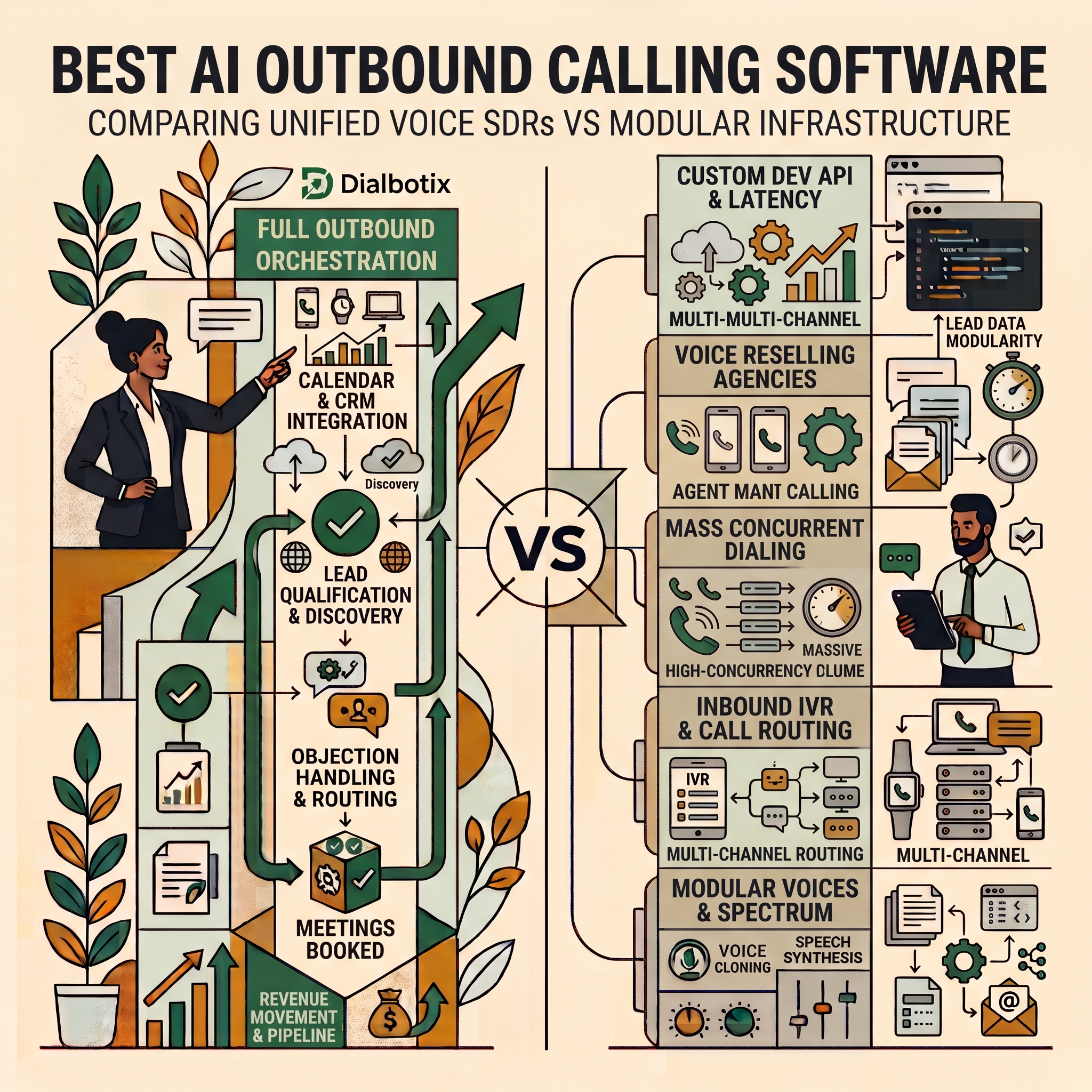
The best AI outbound calling software depends on whether you need a complete sales workflow or voice infrastructure that your team builds around.

AI outbound calling software uses conversational AI to place phone calls to prospects, have real-time conversations, qualify leads, answer questions, follow up, and move qualified prospects toward a defined sales outcome.

The important distinction is that not every AI voice platform is an outbound sales platform. Some products provide developer infrastructure for building voice agents, while others focus on high-volume calling, no-code automation, or complete sales workflows.

For sales teams, the most useful platform is usually the one that reduces the amount of work between a lead list and a qualified meeting. That means looking beyond voice quality and per-minute pricing to qualification logic, campaign management, CRM updates, calendar booking, follow-up, monitoring, and time to launch.

Dialbotix is designed around that complete outbound workflow. It lets teams create an AI voice agent without coding, import or connect leads, launch outbound campaigns, qualify prospects through conversations, follow up, and book meetings without building the underlying voice infrastructure themselves.

Who it's for

Who should use AI outbound calling software?

AI outbound calling is most useful when a business has enough lead volume that manually calling every prospect becomes slow, inconsistent, or expensive.

Sales teams

Automate repetitive prospecting and qualification so sales representatives can spend more time on qualified opportunities.

Appointment-setting teams

Run outbound calling campaigns that identify interested prospects and move them directly toward booked meetings.

Agencies

Operate outbound campaigns for multiple clients without scaling manual calling headcount with every increase in lead volume.

Lead reactivation teams

Revisit older CRM leads and identify prospects who may now be ready to have a sales conversation.

Businesses with large lead lists

Systematically work through hundreds or thousands of prospects instead of relying on manual dialing and inconsistent follow-up.

Teams focused on meetings

Automate the path from initial conversation to qualification and calendar booking.

Methodology

How we evaluate AI outbound calling software

A useful comparison needs to evaluate the entire outbound workflow rather than treating voice generation as the only product capability.

  1. 01

    Outbound calling capabilities

    The platform should support reliable outbound calls, campaign management, calling lists, retries, concurrency, and workflows appropriate for the expected volume.

  2. 02

    Conversation quality

    The AI should respond naturally, handle interruptions, understand prospect responses, and maintain context throughout the conversation.

  3. 03

    Lead qualification

    Sales teams need configurable qualification criteria, structured outcomes, and a reliable way to distinguish interested prospects from unqualified leads.

  4. 04

    Campaign management

    A production outbound system needs more than a single agent. Teams should be able to manage campaigns, lead lists, call outcomes, and follow-up rules.

  5. 05

    Appointment booking

    The best sales workflows connect qualified conversations to real calendar availability instead of stopping at a transcript or scheduling link.

  6. 06

    CRM integrations

    Call outcomes, qualification results, transcripts, and appointments should flow back into the systems where the sales team already manages leads.

  7. 07

    Ease of deployment

    A platform that requires significant engineering work can be a poor fit for a sales team even if the underlying voice technology is powerful.

  8. 08

    Scalability

    The platform should remain operational as call volume, concurrent calls, campaigns, and sales teams grow.

  9. 09

    Total cost

    Pricing should be evaluated across subscriptions, minutes, telephony, model usage, integrations, implementation, and ongoing human operations.

At a glance

Best AI outbound calling software compared

The platforms below solve different parts of the outbound calling problem. Dialbotix is positioned as a complete no-code outbound sales workflow, while several alternatives are primarily voice infrastructure, no-code agent builders, or high-volume calling platforms.

DialbotixThis one

From $79/month

Voice AI
Lead Qualification
Built for sales qualification
Booking
Built-in
CRM
HubSpot, Salesforce, API, webhooks
Outbound
Core workflow
Retell AI

Usage-based

Voice AI
Lead Qualification
Booking
Via integrations
CRM
API / integrations
Outbound
Strong
Bland AI

Usage-based / plans

Voice AI
Lead Qualification
Booking
Via workflows/integrations
CRM
API / integrations
Outbound
Strong, high-volume focus
Synthflow

Usage-based / plans

Voice AI
Lead Qualification
Booking
CRM
Integrations
Outbound
Strong
Vapi

Usage-based

Voice AI
Lead Qualification
Build-dependent
Booking
Build-dependent
CRM
API / custom
Outbound
ElevenLabs

Usage-based / plans

Voice AI
Lead Qualification
Agent-dependent
Booking
Integration-dependent
CRM
API / integrations
Outbound
Air AI

Custom / sales-led

Voice AI
Lead Qualification
Sales-focused
Booking
Workflow-dependent
CRM
Integration-dependent
Outbound
Core use case
IncludedNot available
Verdict

Best AI outbound calling software

There is no universal winner across every technical and operational requirement. This ranking prioritizes businesses that want to use AI for real outbound sales workflows rather than simply build a voice agent.

1

Dialbotix

Best overall for outbound sales

Dialbotix is a no-code AI voice agent platform built around outbound sales workflows. Teams can set up an agent in about two minutes, import or connect leads, run campaigns, qualify prospects, follow up, and book meetings.

Why it ranks here — It ranks first for teams that want the shortest path from a lead list to an automated sales conversation and booked meeting. The product is designed around the complete outbound workflow instead of requiring a team to assemble voice infrastructure, telephony, qualification logic, CRM workflows, and booking separately.

Strengths
  • No-code AI voice agent setup
  • Designed specifically for outbound sales workflows
  • Lead import and campaign management
  • AI lead qualification
  • Automated follow-up
  • Automatic meeting booking
  • CRM sync and webhooks
  • Live call monitoring and transcripts
  • Fast setup without building telephony infrastructure
Trade-offs
  • More specialized around sales workflows than general-purpose developer infrastructure
  • Teams looking for maximum low-level control over every voice component may prefer an API-first platform
Pricing

Starter starts at $79/month for 300 AI calling minutes, with Growth at $149/month for 800 minutes and Scale at $299/month for 2,000 minutes. Pay-as-you-go calling is also available.

Best for

Sales teams, agencies, startups, and businesses that want to automate outbound calling, qualification, follow-up, and appointment booking.

2

Retell AI

Best for production call operations

Retell AI is a production-focused voice agent platform with strong call operations, monitoring, outbound campaigns, and developer capabilities.

Why it ranks here — Retell is a strong choice when call reliability, production operations, developer flexibility, and outbound campaign capabilities matter more than buying a purpose-built sales workflow.

Strengths
  • Strong conversational voice performance
  • Production call monitoring
  • Outbound and batch calling
  • Developer SDK and API
  • Flexible telephony options
  • Strong operational tooling
Trade-offs
  • Teams may still need to build parts of their sales workflow
  • CRM and sales process automation can require integration work
  • More infrastructure-oriented than a dedicated sales application
Pricing

Usage-based pricing varies according to voice, model, telephony, and configuration.

Best for

Teams that want a production-grade voice platform with strong outbound capabilities and developer control.

3

Bland AI

Best for high-volume outbound

Bland AI focuses heavily on automated phone calls and high-volume outbound use cases, making it a natural fit for large calling operations.

Why it ranks here — Bland is particularly compelling when the primary requirement is putting large numbers of outbound calls through an automated voice system. Its outbound orientation makes it one of the stronger infrastructure choices for volume-heavy campaigns.

Strengths
  • Strong outbound orientation
  • High-volume calling
  • Automated phone workflows
  • API access
  • Campaign-oriented capabilities
  • Enterprise-oriented infrastructure
Trade-offs
  • More engineering may be required for a complete sales workflow
  • Teams may need to build CRM, qualification, and booking logic around the calling system
  • Less focused on providing a complete sales application
Pricing

Pricing is primarily usage-based and can vary by plan, volume, telephony, and configuration.

Best for

Organizations running high-volume outbound calling campaigns.

4

Synthflow

Best no-code alternative

Synthflow provides a visual, no-code approach to creating AI phone agents and automating voice workflows.

Why it ranks here — Synthflow is a strong option for teams that prioritize visual workflow building and broad voice automation without wanting to start with a developer-centric API.

Strengths
  • No-code workflow builder
  • Fast agent creation
  • Outbound calling
  • CRM and automation integrations
  • Useful for agencies
  • Visual workflow configuration
Trade-offs
  • Sales-specific workflows may require configuration
  • Complex outbound operations can require more workflow design
  • It is broader than a purpose-built outbound sales application
Pricing

Pricing varies by plan, minutes, models, and usage.

Best for

Agencies and non-technical teams that want to create and operate voice workflows visually.

5

Vapi

Best for developers

Vapi provides developer-oriented infrastructure for building highly customizable voice agents and phone workflows.

Why it ranks here — Vapi is powerful when a technical team wants to control the components and architecture of its voice system. It ranks lower for a sales team because more of the actual outbound application needs to be assembled by the buyer.

Strengths
  • Developer-first architecture
  • High customization
  • Flexible model and voice integrations
  • API and SDK access
  • Custom tools and workflows
Trade-offs
  • Requires engineering for advanced workflows
  • Sales-specific qualification and CRM workflows may need custom development
  • Infrastructure cost is not the same as the total cost of a finished outbound sales system
Pricing

Usage-based pricing depends on the components and providers used in the voice stack.

Best for

Engineering teams building customized voice applications.

6

ElevenLabs

Best for voice quality

ElevenLabs is known primarily for high-quality speech generation and has expanded into conversational AI and voice agents.

Why it ranks here — ElevenLabs is attractive when voice quality and expressive speech are major priorities. For outbound sales automation, however, teams may need to build more workflow infrastructure around the voice layer.

Strengths
  • High-quality synthetic voices
  • Strong voice technology
  • Conversational AI capabilities
  • API access
  • Multilingual capabilities
Trade-offs
  • Not primarily a sales CRM or outbound sales application
  • Sales qualification and campaign workflows may require additional systems
  • Total outbound workflow can require integration work
Pricing

Usage and plan pricing varies according to the selected products and voice usage.

Best for

Businesses where voice quality and expressive speech are major requirements.

7

Air AI

Best for sales-oriented calling

Air AI focuses on AI-driven sales conversations and automated calling, making it relevant for businesses looking for sales-oriented voice automation.

Why it ranks here — Air AI is relevant when the primary goal is automating sales conversations. It ranks below the leading platforms because buyers should evaluate workflow depth, integrations, control, pricing, and operational requirements against their specific sales process.

Strengths
  • Sales-oriented positioning
  • Outbound calling
  • Automated sales conversations
  • Lead engagement
Trade-offs
  • Less flexible than developer-first infrastructure for custom builds
  • Buyers should evaluate integrations and workflow requirements carefully
  • Pricing and deployment may require a sales conversation
Pricing

Pricing is generally sales-led and may vary by deployment and volume.

Best for

Businesses specifically evaluating AI for automated sales conversations.

Deep dive

AI outbound calling software: detailed comparison

Outbound calling capabilities

Outbound calling is the foundation, but the important question is what happens around each call. Campaign management, lead assignment, retries, concurrency, call outcomes, and follow-up determine whether the system can operate as a real sales process.

AI voice quality

Voice quality affects answer rates, trust, interruption handling, and the overall experience. However, natural speech alone does not make a platform effective for outbound sales.

Lead qualification

The AI should be able to ask qualification questions, understand responses, apply defined criteria, and produce structured outcomes that sales teams can act on.

Outbound campaign management

A production outbound operation needs campaigns rather than isolated calls. Look for lead lists, campaign controls, retry logic, statuses, analytics, and the ability to manage multiple agents or campaigns.

AI follow-up

Many leads do not answer the first call. Automated retry and follow-up logic can prevent sales teams from manually revisiting every unanswered prospect.

Appointment booking

For sales teams, the highest-value outcome is often a qualified meeting. The strongest systems can connect the conversation to calendar availability and complete the booking during the interaction.

CRM integration

The calling system should update lead status, qualification results, notes, transcripts, summaries, and meetings without forcing sales representatives to copy information manually.

Telephony and infrastructure

Developer platforms often expose more telephony flexibility, while productized systems abstract much of the underlying infrastructure. Choose based on whether your team needs infrastructure control or operational simplicity.

No-code vs developer platforms

No-code platforms reduce the time required to launch and maintain campaigns. Developer platforms can provide deeper customization but shift more implementation responsibility to engineering.

Monitoring and analytics

Outbound systems need visibility into calls, transcripts, outcomes, failures, and campaign performance. Monitoring becomes increasingly important as call volume grows.

Scalability

Evaluate concurrency, campaign management, infrastructure reliability, call throughput, and operational controls rather than looking only at advertised minutes.

Total cost of ownership

The cheapest per-minute platform is not necessarily the cheapest outbound system. Include telephony, model usage, integrations, engineering, campaign management, and human operations when comparing total cost.

Decision guide

How to choose AI outbound calling software

Start with the sales workflow you want to automate, then work backward into the platform capabilities required to support it.

01

Define the outbound workflow

Decide exactly what should happen from lead import through call, qualification, follow-up, booking, and CRM update.

02

Estimate your call volume

Calculate the number of leads, expected answer rate, average call duration, retry attempts, and monthly calling minutes.

03

Test the conversation

Evaluate interruption handling, objection handling, qualification accuracy, latency, and whether the agent sounds appropriate for your audience.

04

Check your CRM workflow

Call outcomes, lead status, qualification results, transcripts, summaries, and meetings should flow into the systems your sales team already uses.

05

Calculate the real cost

Compare subscriptions, calling minutes, telephony, model costs, integrations, implementation, engineering, and the human work that remains.

06

Measure time to first useful meeting

The best platform is not necessarily the one with the most technical features. Measure how quickly your team can launch campaigns and generate genuinely qualified meetings.

Use cases

AI outbound calling use cases

AI outbound calling can automate more than traditional cold calling. The same conversation engine can be used across prospecting, qualification, follow-up, reactivation, and appointment setting.

Cold outbound prospecting

Call target prospects, introduce the offer, identify interest, and route qualified opportunities to sales representatives.

Lead qualification

Ask predefined qualification questions and determine whether a prospect meets the team's sales criteria.

New lead follow-up

Contact newly submitted leads quickly while buying intent is still fresh.

Cold lead reactivation

Call older CRM leads to identify prospects who may have developed new interest.

Appointment setting

Turn qualified conversations into confirmed sales meetings without requiring a representative to manually coordinate every appointment.

Quote follow-up

Follow up after a proposal or quote, answer basic questions, identify purchase intent, and move interested prospects toward a sales conversation.

Event and webinar follow-up

Call attendees after events or webinars to identify interested prospects and schedule follow-up meetings.

Missed-call and callback campaigns

Automatically return calls or follow up with prospects who previously attempted to reach the business.

Sales pipeline reactivation

Work through dormant opportunities and identify prospects that are ready for another conversation.

Pricing

AI outbound calling software pricing

Pricing varies substantially because these platforms do not all sell the same product. Some sell voice infrastructure, some sell no-code agent builders, and others package the calling workflow into a more complete application.

Dialbotix pricing

Dialbotix currently starts at $79/month for 300 AI calling minutes. Growth is $149/month for 800 minutes, while Scale is $299/month for 2,000 minutes. A pay-as-you-go option is also available at $0.25 per calling minute, and a 14-day free trial is available.

See full pricing
What affects total cost
Monthly platform subscriptionIncluded AI calling minutesAdditional calling minutesTelephony chargesLLM and speech-model costsPhone numbersConcurrent callsCRM integrationsAPI and webhook usageImplementation and engineeringCampaign managementHuman sales operations

Do not compare AI outbound calling platforms solely by their advertised per-minute rate. Infrastructure products can expose a low platform fee while leaving model, telephony, integration, engineering, and workflow costs to the buyer. The useful number is the fully loaded cost of generating a qualified sales opportunity.

FAQ

AI outbound calling software FAQs

What is AI outbound calling software?

AI outbound calling software uses conversational AI to automatically place phone calls to prospects or customers. Depending on the platform, it can qualify leads, answer questions, follow up, schedule appointments, and update business systems.

What is the best AI outbound calling software?

For businesses that want a complete outbound sales workflow rather than voice infrastructure alone, Dialbotix is a strong fit because it combines AI calling, lead qualification, campaign management, follow-up, CRM connectivity, and appointment booking.

Can AI outbound calling software qualify leads?

Yes. AI voice agents can ask predefined qualification questions, interpret responses, apply qualification criteria, and record the outcome for the sales team.

Can AI outbound calling software book appointments?

Yes. Platforms with calendar integrations can move a qualified prospect directly from the phone conversation to an available appointment slot.

Can AI outbound calling software call leads from a CSV?

Yes. Dialbotix supports CSV lead imports, allowing businesses to load lead lists and assign them to outbound campaigns.

Can AI outbound calling software integrate with a CRM?

Yes. Depending on the platform, CRM connectivity can be provided through native integrations, APIs, webhooks, or custom workflows. Dialbotix supports HubSpot, Salesforce, APIs, webhooks, and lead imports.

Can an AI voice agent follow up with leads?

Yes. Follow-up can include retries for unanswered calls, additional qualification conversations, and scheduled outreach depending on the platform and campaign configuration.

Is AI outbound calling the same as an AI SDR?

Not necessarily. AI outbound calling describes the calling capability, while an AI SDR usually refers to a broader sales workflow that can include prospecting, qualification, follow-up, and meeting generation.

Is AI outbound calling better than human cold calling?

AI and human callers are suited to different parts of the sales process. AI is particularly useful for repetitive, high-volume prospecting and qualification. Humans remain important for complex objections, relationship building, negotiation, and closing.

How much does AI outbound calling cost?

Costs range from usage-based voice infrastructure to complete software subscriptions and enterprise deployments. Dialbotix currently starts at $79/month, while other platforms may charge primarily by minute, by plan, or through custom enterprise pricing.

What should I look for in an AI outbound calling platform?

Evaluate conversation quality, outbound campaign management, lead qualification, follow-up, appointment booking, CRM integration, monitoring, scalability, compliance requirements, setup time, and fully loaded cost.

Can AI outbound calling handle objections?

A well-configured AI voice agent can respond to common objections and follow predefined conversation logic. Complex, sensitive, or high-value objections may still be better handled by a human representative.

Do AI outbound calling platforms require coding?

Some platforms are developer-first and require engineering work, while others provide no-code or low-code builders. Dialbotix is designed as a no-code platform where users can set up an AI voice agent without writing code.

How quickly can I launch an AI outbound calling campaign?

The setup time depends heavily on the platform and workflow complexity. Dialbotix is designed so a user can create and configure a voice agent in about two minutes without writing code.

What is the difference between AI outbound calling software and voice AI infrastructure?

Voice AI infrastructure provides the underlying components for building phone agents, while outbound calling software generally packages those capabilities into a workflow for actually managing leads, campaigns, calls, qualification, follow-up, and sales outcomes.

Turn your lead list into sales conversations

Dialbotix lets you create a no-code AI voice agent, launch outbound campaigns, qualify leads through real conversations, follow up with prospects, and book qualified meetings.