All comparisons
Air AI Alternatives

The Best Air AI Alternatives

Compare the strongest alternatives for AI-powered outbound calling, lead qualification, appointment booking, and sales automation. Find the platform that best matches your workflow, technical requirements, and sales goals.

Overview
Why look for Air AI alternatives?

Why look for Air AI alternatives?

The Air AI name has historically been associated with AI-powered sales calling, but the company behind air.ai has since repositioned around Air Enterprise Readiness, an AI-native platform for national-security and defense workflows. That makes the current Air product materially different from the sales-focused category buyers may have originally searched for.

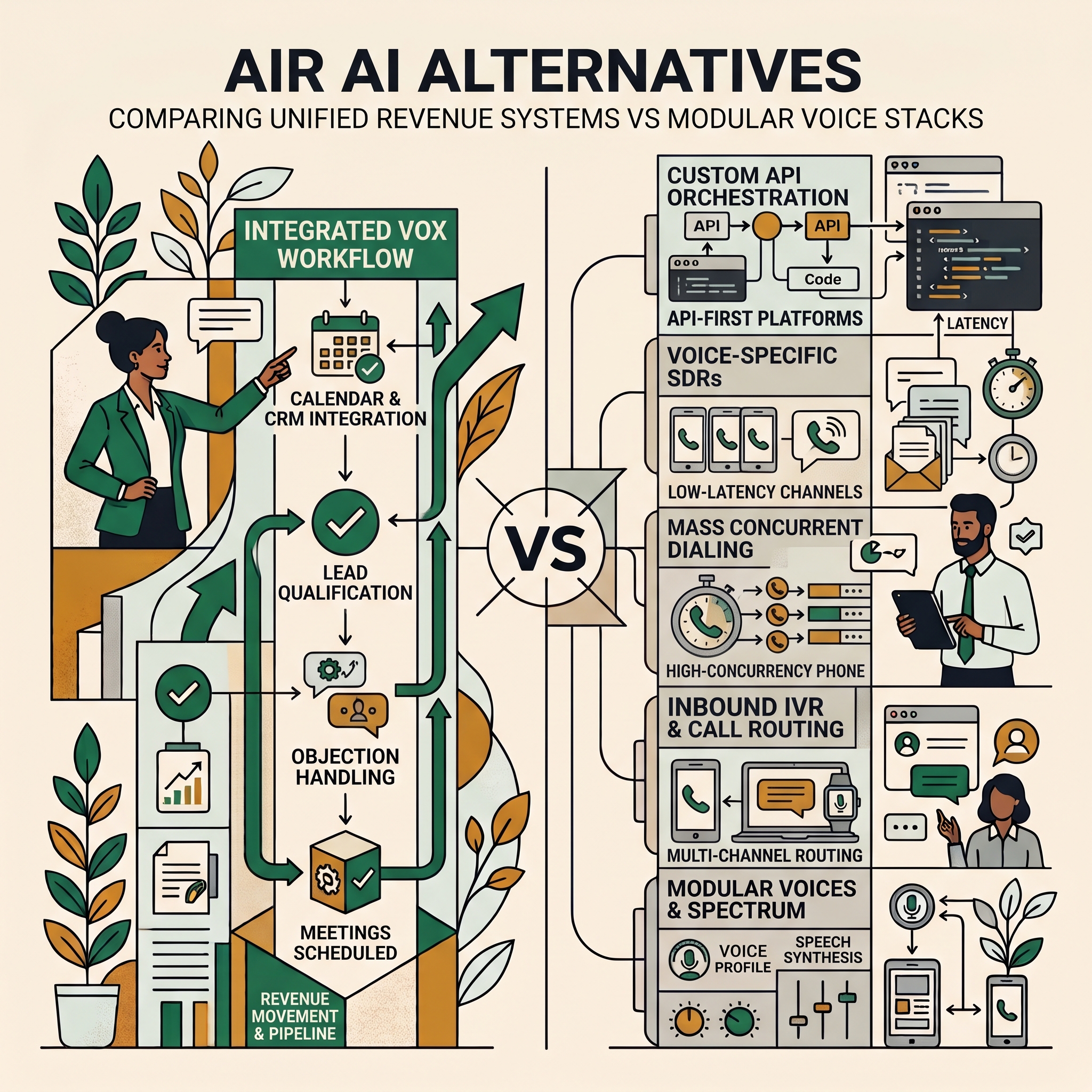
If your actual goal is outbound sales automation, the better comparison is between purpose-built AI voice agents and voice platforms that can support calling, qualification, follow-up, and appointment booking.

Dialbotix takes a productized approach: instead of assembling voice infrastructure yourself, you can configure an AI voice agent for outbound sales, import leads, run campaigns, qualify conversations, and book meetings without writing code.

Other platforms take different approaches. Retell and Vapi provide flexible voice infrastructure, Synthflow focuses on no-code voice automation, Bland AI provides programmable phone-agent infrastructure, and ElevenLabs focuses heavily on voice technology and conversational AI.

The right alternative depends less on the brand name and more on whether you need a ready-to-run sales workflow, flexible developer infrastructure, enterprise deployment, or broader conversational automation.

Who it's for

Who should consider an Air AI alternative?

The strongest alternative depends on what you actually need from an AI calling platform. These are the most common situations where evaluating alternatives makes sense.

You need outbound sales automation

Choose a platform built around outbound campaigns, lead qualification, follow-up, and sales conversations rather than general-purpose voice infrastructure.

You need developer control

Developer-first platforms can be a better fit when your team needs APIs, custom orchestration, telephony control, and deep application-level integration.

You want no-code setup

No-code platforms reduce the engineering work required to launch and maintain AI phone agents.

You care about appointment booking

If meetings are the commercial outcome, prioritize platforms that support qualification and booking as part of the workflow.

You need scalable lead outreach

Sales teams with large lead lists need campaign management, calling capacity, qualification logic, and usable reporting.

You need a different deployment model

Some teams need a self-serve SaaS product while others need enterprise implementation, custom integrations, or developer infrastructure.

Methodology

How we evaluate Air AI alternatives

An AI voice platform should not be judged only by how natural the voice sounds. For sales use cases, the operational workflow around the conversation is equally important.

  1. 01

    Voice quality

    The agent should produce natural speech, handle interruptions, and maintain a usable conversational experience.

  2. 02

    Outbound calling

    Evaluate how effectively the platform supports campaigns, lead lists, outbound workflows, and calling at scale.

  3. 03

    Lead qualification

    The system should be able to follow qualification logic and identify meaningful buying signals from conversations.

  4. 04

    Appointment booking

    Look for calendar integration and the ability to move qualified prospects directly into booked meetings.

  5. 05

    CRM integration

    Sales teams need lead data, call outcomes, transcripts, summaries, and qualification results to flow back into their systems.

  6. 06

    Ease of deployment

    A platform that requires extensive engineering can dramatically increase the time and cost of an initial pilot.

  7. 07

    Customization

    Evaluate prompts, conversation logic, agent behavior, integrations, and workflow controls.

  8. 08

    Analytics

    Call outcomes, transcripts, summaries, campaign performance, and qualification metrics should be accessible to the sales team.

At a glance

Air AI alternatives compared

These platforms approach AI voice differently. Dialbotix is focused on outbound sales workflows, while other alternatives emphasize voice infrastructure, no-code automation, enterprise conversational AI, or voice technology.

DialbotixThis one

$79/mo+

Voice AI
Lead Qualification
Built for sales
Booking
Built-in
CRM
Outbound
Core use case
Retell

Usage-based

Voice AI
Lead Qualification
Custom
Booking
Custom
CRM
Via integrations
Outbound
Synthflow

Usage/subscription

Voice AI
Lead Qualification
Booking
CRM
Integrations
Outbound
Bland AI

Usage + plans

Voice AI
Lead Qualification
Booking
CRM
Integrations/webhooks
Outbound
Vapi

Usage-based

Voice AI
Lead Qualification
Custom
Booking
Custom
CRM
API/integrations
Outbound
ElevenLabs

Plan/usage-based

Voice AI
Lead Qualification
Custom
Booking
Custom
CRM
Custom
Outbound
Possible
PolyAI

Custom

Voice AI
Lead Qualification
Enterprise
Booking
Custom
CRM
Enterprise
Outbound
Not primary
IncludedNot available
Verdict

The best Air AI alternatives

There is no single winner for every company. The ranking below prioritizes practical fit for businesses evaluating AI voice agents, with extra weight given to outbound sales, qualification, booking, and deployment simplicity.

1

Dialbotix

Best for outbound sales

Dialbotix is a purpose-built AI voice agent platform for outbound sales. It combines AI calling, lead qualification, appointment booking, campaign management, CRM synchronization, transcripts, summaries, and analytics in one workflow.

Why it ranks here — It is the strongest choice when the objective is not simply making AI phone calls but turning a lead list into qualified conversations and booked meetings. The platform is designed as a no-code product, allowing teams to set up a voice agent in about two minutes without writing code.

Strengths
  • Purpose-built for outbound sales
  • No-code AI voice agent setup
  • Lead qualification workflows
  • Automatic meeting booking
  • Campaign management
  • CRM synchronization
  • Call transcripts and summaries
  • Live call monitoring
  • API and webhooks
  • 14-day free trial
Trade-offs
  • More specialized than general-purpose voice infrastructure
  • Best suited to teams whose primary goal is sales conversations and lead conversion
Pricing

Starter $79/month for 300 AI calling minutes; Growth $149/month for 800 minutes; Scale $299/month for 2,000 minutes; pay-as-you-go at $0.25 per call minute.

Best for

Sales teams that want to launch outbound AI voice campaigns without building the underlying voice infrastructure.

2

Synthflow

Best no-code alternative

Synthflow is a no-code voice AI platform designed for building and deploying conversational phone agents across multiple business workflows.

Why it ranks here — It is a strong alternative when flexibility across use cases matters more than having a product specifically optimized around outbound sales.

Strengths
  • No-code workflow builder
  • Broad voice-agent use cases
  • Appointment workflows
  • Integrations
  • Business automation
Trade-offs
  • Less narrowly focused on sales than Dialbotix
  • Complex workflows can require more configuration
  • Pricing depends on usage and plan structure
Pricing

Subscription and usage-based pricing depending on configuration and requirements.

Best for

Businesses that want no-code voice automation across multiple workflows.

3

Retell

Best voice infrastructure

Retell provides infrastructure for building production-grade AI phone agents with significant control over the voice experience and application logic.

Why it ranks here — It is a strong choice for teams that want a flexible voice layer and have engineering resources available to build their own sales workflows.

Strengths
  • Voice agent infrastructure
  • Developer control
  • Telephony support
  • Custom conversation logic
  • Production-oriented tooling
Trade-offs
  • More infrastructure-oriented
  • Sales workflows may require additional implementation
  • Engineering involvement can increase deployment effort
Pricing

Primarily usage-based, with costs depending on voice and telephony configuration.

Best for

Technical teams building customized AI phone applications.

4

Bland AI

Best programmable phone agents

Bland AI provides programmable AI phone-agent infrastructure for inbound and outbound calling, with workflows that can be connected to business systems.

Why it ranks here — Bland is a strong option when calling infrastructure and programmability are priorities, particularly for teams that want to build customized phone workflows.

Strengths
  • Outbound calling
  • Programmable phone agents
  • CRM and webhook workflows
  • Appointment scheduling
  • Enterprise-oriented capabilities
Trade-offs
  • More infrastructure-oriented than a dedicated sales application
  • Customization can require additional implementation
  • Pricing varies by plan and usage
Pricing

Plans include usage-based calling with higher tiers adding platform capabilities.

Best for

Companies building custom high-volume phone-agent workflows.

5

Vapi

Best for developers

Vapi is a developer-focused platform for building voice AI applications with APIs and configurable components.

Why it ranks here — Vapi makes sense when your engineering team wants control over the underlying voice application rather than a fully packaged sales product.

Strengths
  • Developer-first architecture
  • API flexibility
  • Voice AI infrastructure
  • Custom workflows
  • Integration flexibility
Trade-offs
  • Requires more technical implementation
  • Sales workflows are not the central product abstraction
  • Engineering resources are generally needed
Pricing

Usage-based pricing with costs depending on the underlying voice and telephony stack.

Best for

Developers building custom AI voice applications.

6

ElevenLabs

Best voice technology

ElevenLabs is primarily known for advanced AI voice and speech technology, while also supporting broader conversational AI applications.

Why it ranks here — It is compelling when voice quality and speech technology are central requirements, but companies building outbound sales systems may still need additional application infrastructure.

Strengths
  • Advanced voice technology
  • Natural speech generation
  • Voice customization
  • Developer APIs
  • Broad AI audio ecosystem
Trade-offs
  • Not primarily a sales execution platform
  • Outbound qualification workflows may require additional systems
  • CRM and sales orchestration can require custom development
Pricing

Plan and usage-based pricing depending on the selected voice and AI capabilities.

Best for

Teams prioritizing voice technology and custom conversational applications.

7

PolyAI

Best for enterprise conversations

PolyAI focuses on enterprise conversational AI, particularly complex customer-service and phone interactions.

Why it ranks here — It is a strong enterprise option for organizations that need sophisticated conversational automation, but it is not as directly aligned with self-serve outbound sales as Dialbotix.

Strengths
  • Enterprise conversational AI
  • Complex customer interactions
  • Natural voice conversations
  • Large-scale deployments
  • Enterprise support
Trade-offs
  • Enterprise-oriented deployment
  • Not primarily an outbound sales platform
  • Typically requires a larger implementation process
Pricing

Enterprise/custom pricing.

Best for

Large organizations automating complex customer-service conversations.

Deep dive

Air AI alternatives: detailed comparison

Dialbotix vs Air AI

The key distinction is current product direction. Air now positions itself around Enterprise Readiness for national-security and defense workflows, while Dialbotix is purpose-built for commercial outbound sales, AI calling, qualification, and appointment booking.

Dialbotix vs Synthflow

Dialbotix is more specifically focused on sales workflows, while Synthflow provides broader no-code voice automation.

Dialbotix vs Retell

Dialbotix packages the sales workflow into a product, while Retell provides flexible voice infrastructure for teams building custom applications.

Dialbotix vs Bland AI

Both support outbound calling, but Dialbotix emphasizes the complete sales workflow while Bland AI provides programmable phone-agent infrastructure.

Dialbotix vs Vapi

Dialbotix targets business users who want a ready-to-use sales system, while Vapi is primarily a developer platform for constructing custom voice applications.

Dialbotix vs ElevenLabs

ElevenLabs is heavily focused on voice and speech technology, whereas Dialbotix focuses on converting outbound conversations into qualified leads and meetings.

No-code AI voice agents

No-code platforms can reduce engineering requirements and make it easier for sales teams to launch voice campaigns independently.

AI outbound calling

Outbound calling platforms should be evaluated on campaign management, call quality, qualification, follow-up, and measurable business outcomes.

AI lead qualification

The strongest sales agents do more than place calls. They identify intent, ask qualification questions, and route meaningful opportunities to sales teams.

AI appointment setting

Appointment-setting systems should connect conversational qualification directly to calendar availability and meeting creation.

CRM integration

CRM synchronization is important because call outcomes should become usable sales data rather than isolated recordings.

AI voice agent analytics

Look for transcripts, summaries, call outcomes, campaign metrics, and qualification analytics when evaluating a production sales system.

Decision guide

How to choose the right Air AI alternative

Start with the outcome you need rather than the voice technology itself. The right platform is the one that minimizes the gap between launching an agent and producing measurable business results.

1

Define the workflow

Decide whether you need outbound sales, lead qualification, appointment setting, customer service, inbound reception, or a broader conversational workflow.

2

Choose your technical depth

If your team wants to configure an agent without engineering, prioritize no-code products. If you have developers and need application-level control, infrastructure platforms may be better.

3

Evaluate qualification

Determine whether the agent can follow your qualification criteria and produce structured outcomes that sales teams can act on.

4

Check booking workflows

If meetings are the goal, confirm that the platform can connect conversations to calendars and create appointments without unnecessary manual steps.

5

Review integrations

Check CRM, calendar, webhook, API, lead-import, and data-export capabilities before committing to a platform.

6

Calculate total cost

Compare not only per-minute calling costs but also platform fees, implementation effort, engineering time, integrations, and the cost of maintaining the workflow.

Pricing

Pricing considerations when comparing Air AI alternatives

AI voice pricing is difficult to compare using a single per-minute number. Your real cost depends on calling volume, telephony, model usage, platform fees, integrations, implementation, and how much engineering work your team must provide.

Dialbotix pricing

Dialbotix offers Starter at $79/month for 300 AI calling minutes, Growth at $149/month for 800 minutes, and Scale at $299/month for 2,000 minutes. Pay-as-you-go calling is available at $0.25 per call minute, with a 14-day free trial.

See full pricing
What affects total cost
AI calling minutesTelephony chargesPlatform subscriptionVoice and model usageNumber provisioningCRM integrationsAPI and webhook usageImplementation costsEngineering requirementsHuman sales follow-up costs

Do not compare platforms solely by headline per-minute pricing. A cheaper voice layer can become more expensive overall if your team must build qualification, CRM synchronization, appointment booking, campaign management, monitoring, and reporting around it.

FAQ

Air AI alternatives FAQ

What is the best Air AI alternative?

For businesses looking for an AI voice agent specifically for outbound sales, Dialbotix is a strong alternative because it combines calling, lead qualification, appointment booking, campaigns, CRM synchronization, and analytics in one product.

Is Air AI still an AI sales calling platform?

The current air.ai website positions Air as Air Enterprise Readiness, an AI-native platform focused on national-security and defense workflows. Businesses searching for an AI sales-calling product should therefore evaluate dedicated sales voice platforms instead.

What happened to Air AI?

Air has repositioned its current business around Enterprise Readiness. Its website describes a platform for connecting operational, commercial, supplier, and enterprise data across national-security workflows.

What is the best Air AI alternative for outbound sales?

Dialbotix is a strong fit when outbound sales is the primary use case because its workflow is centered on AI calling, qualification, appointment booking, CRM updates, and campaign management.

Is Dialbotix a no-code Air AI alternative?

Yes. Dialbotix is designed as a no-code AI voice agent platform. Teams can configure an outbound agent and launch campaigns without writing a line of code.

Can Air AI alternatives qualify leads?

Yes. Several AI voice platforms can be configured for qualification. The important difference is whether qualification is a native part of the sales workflow or something your team must build around a voice infrastructure layer.

Can AI voice agents book appointments?

Yes. Platforms with calendar integrations can use conversations to identify qualified prospects and schedule meetings. The depth of the booking workflow varies by platform.

What is the best no-code alternative to Air AI?

Dialbotix and Synthflow are strong no-code options, with Dialbotix being more specifically focused on outbound sales workflows.

Is Retell an Air AI alternative?

Retell can be an alternative if you need voice-agent infrastructure and want to build your own calling workflows. It is more infrastructure-oriented than a packaged outbound sales system.

Is Bland AI an Air AI alternative?

Bland AI can serve as an alternative for programmable AI phone agents and outbound calling. It is particularly relevant for teams that want customizable phone infrastructure.

Is Vapi an Air AI alternative?

Vapi is an alternative for developers who want APIs and infrastructure for building custom voice agents. It generally requires more technical implementation than a purpose-built sales product.

Is ElevenLabs an Air AI alternative?

ElevenLabs can be used as part of conversational voice applications and is particularly strong in voice technology. Businesses looking for a complete outbound sales workflow may need additional systems around it.

How much does Dialbotix cost?

Dialbotix currently offers Starter at $79/month, Growth at $149/month, and Scale at $299/month, plus a pay-as-you-go option at $0.25 per call minute.

Do Air AI alternatives integrate with CRMs?

Many do, either through native integrations, APIs, webhooks, or custom development. CRM connectivity should be evaluated based on the exact CRM and workflow your sales team uses.

What should I look for in an AI voice agent?

Prioritize voice quality, outbound calling, qualification logic, appointment booking, CRM integration, campaign management, analytics, reliability, ease of deployment, and total operating cost.

Build your AI voice agent without the complexity

If your goal is outbound sales, lead qualification, and booked meetings, you do not need to assemble a voice stack from scratch. Set up a Dialbotix AI voice agent, launch your campaign, and start qualifying leads.